
Have A Case? Call Us
1 888-536-6671
60 Second Lemon Law Assessment™
60 Second Lemon Law Assessment™
by Kahn & Associates - September 21st, 2026
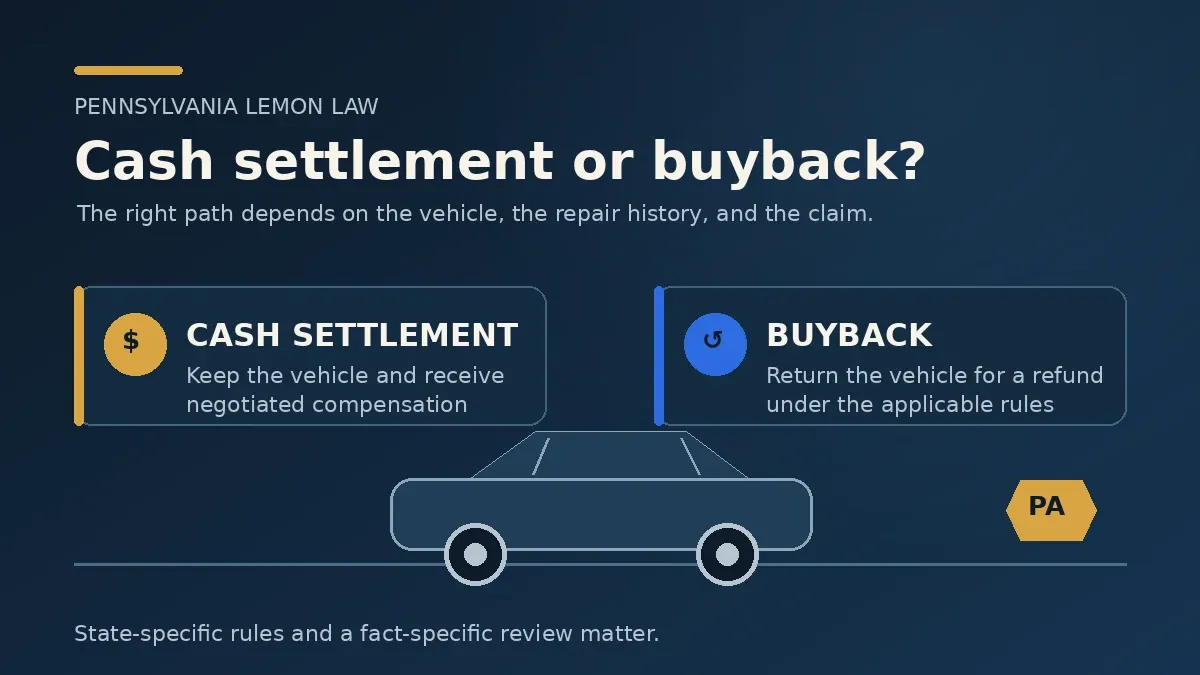
When a manufacturer moves to resolve a Pennsylvania claim, the offer usually takes one of two forms: a cash payment while you keep the vehicle, or a buyback in which the manufacturer takes the vehicle back and refunds you or replaces the vehicle. Owners naturally want to know which one is better. The more useful question is which one your claim actually supports, because that is normally what determines the offer you receive in the first place.
If your vehicle has been in for the same issue at least twice, or has been or will be out of service for at least 21 calendar days, find out where you stand. Call 1-888-536-6671 or complete our free 60-Second Lemon Law Assessment. We have focused exclusively on Lemon Law since 1996, and as of the beginning of 2026 we have recovered more than $65 million for consumers. You are not required to pay us any out-of-pocket fees or costs, win or lose.
The two outcomes are explained below, followed by a side-by-side comparison and an explanation of what normally decides which one is available.
A Pennsylvania lemon law buyback, also called a repurchase, is a resolution in which the manufacturer accepts the defective vehicle back and refunds the purchase price or lease price under the applicable requirements or replaces the vehicle. The Pennsylvania Automobile Lemon Law protects qualifying buyers and lessees of new vehicles registered in Pennsylvania when a nonconformity substantially impairs the vehicle’s use, value, or safety.
The problem generally must arise within the law’s coverage period: the first 12 months, the first 12,000 miles, or the term of the manufacturer’s warranty, whichever occurs first. The manufacturer must receive a reasonable opportunity to repair it. A reasonable number of repair attempts, or an unreasonable amount of time out of service, can support a lemon-law claim, but no single fact automatically guarantees a buyback.
One point worth understanding is that the statutory remedy actually has two forms. The manufacturer may replace the vehicle with a comparable one, or accept the vehicle back and refund you. People use “buyback” loosely to mean both, but a replacement is a swap: you hand over the defective vehicle and drive away in another, without the refund calculation, the mileage allowance, or the payoff mechanics that come with a repurchase. For some owners that is the simpler outcome, particularly where they are happy with the model and the problem is this particular vehicle.
Pennsylvania does not leave the choice to the manufacturer. Where the statutory remedy applies and the consumer prevails in court, you have the right to demand a refund rather than accept a comparable replacement vehicle. A refund can involve the purchase or lease price and collateral charges, with payment made to the purchaser and the lienholder according to their interests. In practical terms the outstanding loan is paid off as part of the remedy: the lienholder is paid directly, and you are separately returned what you have put into the vehicle, so the financing is retired rather than carried into your next vehicle.
Pennsylvania’s mileage rule matters when comparing the two outcomes. The allowance for the consumer’s use cannot exceed the lesser of 10 cents per mile driven at the first repair attempt or 10% of the vehicle’s purchase or lease price. The calculation is tied to use before the first report of the nonconformity to the manufacturer, so the first repair or report date and the mileage recorded then can matter significantly. Our Pennsylvania Lemon Law mileage-offset guide explains the issue in more detail.
That calculation differs from the rules in other states. Do not apply an Ohio, Florida, Michigan, or North Carolina calculation to a Pennsylvania claim.
There is also a cost to waiting while you consider an offer. Every month you keep driving the vehicle and adding miles gives the manufacturer an argument that the defect is not substantially impairing its use, value, or safety. A vehicle driven for a long stretch after the repairs looks, to a manufacturer’s lawyer, like a vehicle that works.
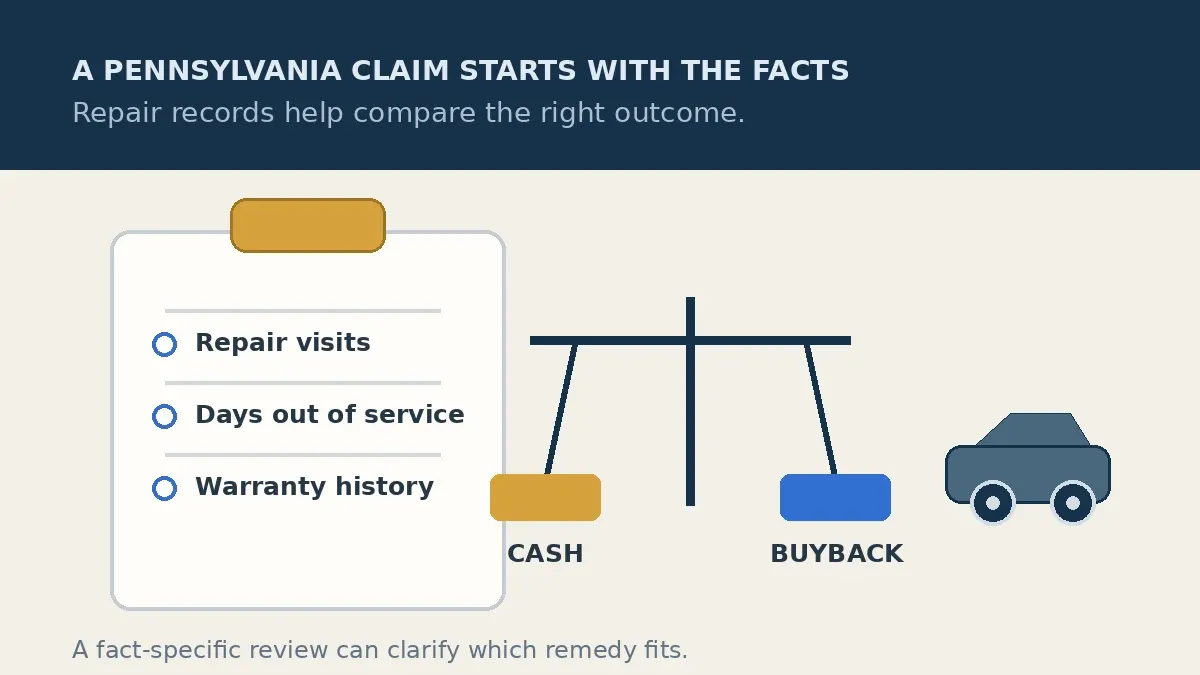
A cash settlement generally means the consumer keeps the vehicle and the manufacturer pays an agreed amount to resolve the dispute. It is sometimes called a cash-and-keep settlement. The payment may reflect the vehicle’s diminished value, loss of use, inconvenience, repair history, safety concerns, or the cost and risk the manufacturer avoids by resolving the claim.
A cash settlement is not a statutory buyback. It is normally negotiated as a resolution of a warranty or breach of warranty claim, including a claim under the federal Magnuson-Moss Warranty Act where that law fits the facts. The amount is not set by any Pennsylvania cash-settlement chart, and an online estimate cannot establish eligibility or value.
Keeping the vehicle is not the same as being stuck with it. After a cash settlement you remain free to trade it in or sell it whenever you choose. The money can go toward negative equity on the loan, serve as a down payment on a replacement, or you can simply keep it and keep driving. Owners who want out of the vehicle can still get out of it; the settlement funds that decision rather than making it for them.
With both outcomes described, the differences are easier to see side by side. This is a starting point rather than a promise of a particular result; the available remedy depends on the vehicle, the nonconformity, the repair attempts, the documents, and which legal path fits the claim.
| Issue | Cash settlement | Buyback |
| What happens to the vehicle? | You keep it, but can still trade it in or sell it if you wish. | You return it to the manufacturer, either for a refund or in exchange for a comparable replacement vehicle. |
| What do you receive? | A negotiated payment that may address diminished value, loss of use, inconvenience, or other claim-related harm. | Either a comparable replacement vehicle, or a refund calculated under the Pennsylvania rules: the purchase or lease price, collateral charges, the lienholder payoff, and any permitted mileage allowance. |
| Is there a fixed formula? | No. The amount is negotiated and depends on the evidence and the claim. | Yes, in substantial part. Pennsylvania’s statutory refund rules govern the components and cap the allowance for use. |
| When does it apply? | Usually when the claim does not meet the state statute, and resolves under federal warranty law instead. Occasionally by preference on one side or the other. | When the claim qualifies under the Pennsylvania Lemon Law. |
| Who decides? | Rarely the consumer alone. Which remedy is on the table normally follows from whether the claim qualifies under the State Lemon Law. | Same. If you win at court, Pennsylvania gives the consumer the right to demand a refund rather than a replacement. |
This is the question most comparisons skip. Which remedy is on the table normally depends on whether the claim qualifies under the Pennsylvania Lemon Law statute, not on which one the consumer would prefer.
A buyback or replacement is normally the path when the claim meets the state statute: the vehicle is within the coverage period, the nonconformity substantially impairs use, value, or safety, and the repair history or time out of service shows the manufacturer had a reasonable opportunity to fix it. Where that is true, the statutory remedy is available in either form, and Pennsylvania gives the consumer the right to demand a refund rather than accept a replacement vehicle.
A cash settlement is normally the path when the claim does not meet the state statute, and resolves under federal law as a breach of warranty instead. That is the most common reason cash is the only offer. It also happens less often in the other direction: a manufacturer may prefer a cash resolution because the buyback numbers do not work for it, and occasionally a consumer who does qualify will pass on a buyback because the repurchase figures do not work for them or replacement vehicles have become too expensive.
So the useful question is not which you would rather have. It is what the repair history and the governing law actually support, and that is what a case review establishes.
Either way, read the written terms before signing any release. A settlement may release future claims involving the same vehicle or defect, which matters most when the problem is safety-related, remains active, or could return.
The Pennsylvania Lemon Law is not the only path for a defective vehicle. A vehicle may fall outside the strict state-law window, or fail to meet a particular presumption, while still presenting a breach of warranty issue. The federal Magnuson-Moss Warranty Act turns on the existence of a written manufacturer warranty rather than the vehicle’s age or mileage, and implied warranty principles may apply as well.
That is also where the used-vehicle question lands. A common misconception is that the vehicle has to be under warranty right now. It does not. What matters is that repairs were performed under the manufacturer’s warranty or the manufacturer’s extended warranty, and there may be an implied warranty claim alongside a claim for breach of the written warranty.
On fees: many state lemon laws provide that a prevailing consumer’s attorney fees shall be paid, while the federal act provides that they may be awarded. In a negotiated settlement, especially one reached before a lawsuit is filed, the manufacturer’s payment of attorney fees is a term typically agreed by the parties rather than a court award. You are not required to pay us any out-of-pocket fees or costs, win or lose. Our fee comes from the recovery, not from any money in your pocket before the case resolves.
You do not need to build a chart or organize every repair order before contacting us. Those records help, but a preliminary review can begin with what you remember and what you have on hand.
We can then identify whether the facts point toward a Pennsylvania Lemon Law refund, a comparable replacement, a negotiated cash settlement, or another warranty remedy. For context on the broader range of resolutions, see our guide to lemon law settlement examples and the separate lemon law buyback process guide, along with our Pennsylvania Lemon Law overview.
No. A cash settlement usually lets you keep the vehicle and provides compensation. A buyback requires the vehicle to be returned and is structured as a refund or repurchase under the applicable rules. The two have different effects on your loan, title, future claims, and responsibility for the vehicle.
Usually not, and this is the most common misunderstanding about these two outcomes. Which remedy is available normally depends on whether the claim qualifies under the Pennsylvania Lemon Law statute. Where it does, a repurchase or replacement is the statutory remedy and the consumer can demand a refund. Where it does not, cash is typically the only offer, with the matter resolving under federal law as a breach of warranty. Sometimes a consumer can opt for cash instead of a buyback if the numbers don’t work.
Does a buyback mean I can get a replacement vehicle instead?
Often, yes. The Pennsylvania statutory remedy comes in two forms: a comparable replacement vehicle or a refund. A replacement is effectively a swap, without the refund calculation, mileage allowance, and payoff mechanics of a repurchase.
There is no single formula. The amount can depend on the severity and duration of the defect, the repair attempts, amount paid, safety impact, diminished value, loss of use, inconvenience, the available warranty theories, and the strength of the records. A case-specific review is more reliable than a generic percentage or an online calculator.
Yes. A Pennsylvania refund includes payment to the purchaser and lienholder according to their interests, so the lienholder is paid directly and you are separately returned what you have put in. The exact payoff and any remaining balance depend on the purchase documents, the loan or lease, the settlement terms, and applicable law.
Yes. Pennsylvania limits the allowance for use to no more than the lesser of 10 cents per mile at the first repair attempt or 10% of the purchase or lease price. The relevant mileage and report timing matter, so the calculation should be checked against the repair and warranty records rather than copied from another state.
A used vehicle may still support a claim when repairs were performed under the manufacturer’s warranty or extended warranty. The vehicle does not need to be under warranty today for a federal warranty claim, though the repair and warranty history must support it. Ask for a free case review before assuming the claim is excluded.
Choosing between a cash settlement and a buyback is rarely a simple choice between a check and a vehicle return, and it is often not a choice at all. What decides it is the defect, the evidence, the mileage allowance, the loan or lease, the release language, and which legal remedy the facts actually support.
Two repair visits for the same issue, or 21 calendar days out of service, is enough to find out where you stand. Call 1-888-536-6671 or complete the 60-Second Lemon Law Assessment. Kahn & Associates represents consumers in Pennsylvania, Ohio, Florida, Michigan, and North Carolina, and you are not required to pay us any out-of-pocket fees or costs, win or lose.
*Disclaimer: The information contained in this Website is provided for informational purposes only, and should not be construed as offering legal advice, or creating an attorney client relationship between the reader and the author. While we aim for accuracy, the law is constantly changing and we make no guarantees regarding the completeness or timeliness of the information. You should not act or refrain from acting on the basis of any content included in this Website without seeking appropriate legal advice about your individual facts and circumstances from an attorney licensed in your state.
To see if you qualify, fill out the form below or call us at 1-888-536-6671 – No Office Visit Needed!

I had a great experience with Kahn & Associates! They made the process of dealing with an extremely frustrating lemon situation painless. They have very quick response times and everyone I dealt with was very friendly and helpful. Would definitely recommend!
Kahn and Associates did an awesome job with our lemon law case! We were getting nowhere with VW Customer Service and decided to hire an attorney who specialized with lemon law cases. We couldn’t be happier with the outcome. We were able to get a full refund on our lemon VW Atlas.
What a great experience! I was on the fence about hiring an attorney for my ongoing automotive issues and continued frustration with the manufacturer. It was a very simple process and I am very grateful Kahn and Associates for helping get me a settlement!
Real Honest attorneys!!! They are the real deal! I went back and forth with them and they explained to me every step and my rights under the law! I give them 5 stars because I won!!! Yes and my check is coming to me much sooner than I thought! I was stuck ! I own a brand new car and the dealer was giving me a hard time !

This page has been written, edited, and reviewed by a team of legal writers following our comprehensive editorial guidelines. This page was approved by Attorney Craig A. Kahn, who has more than 20 years of legal experience in lemon law.
It’s beyond frustrating. You bought or leased a new vehicle, but it spends more time at the dealershi...
Every dealership visit can strengthen or weaken the record behind your warranty claim. A missing date, vagu...
Repeated transmission shuddering or an engine that burns oil between services turns a car you trusted into ...

Stuck with a defective car in Ohio? State Lemon Laws protect you. Get a refund, replacement, or cash settlement. Learn your rights today!

Florida Lemon Laws cover new and used vehicles. If your car’s a lemon, you deserve compensation. Let us help you fight for justice!

Michigan’s Lemon Law protects you from faulty vehicles. Don’t settle for endless repairs—claim your refund or replacement now.

North Carolina Lemon Laws ensure defective vehicles are replaced or refunded. Know your rights and take action today!

Pennsylvania Lemon Law covers new cars with repeated issues. Get the compensation you deserve. Click to learn more!
To see if you qualify, fill out the form below or call us at 1-888-536-6671 – No Office Visit Needed!

The Truth About Attorney’s Fees in Lemon Law Cases Learn more
*Disclaimer: The information contained in this Website is provided for informational purposes only, and should not be construed as offering legal advice, or creating an attorney client relationship between the reader and the author. While we aim for accuracy, the law is constantly changing and we make no guarantees regarding the completeness or timeliness of the information. You should not act or refrain from acting on the basis of any content included in this Website without seeking appropriate legal advice about your individual facts and circumstances from an attorney licensed in your state.

 Message Us
 Call Us