
Have A Case? Call Us
1 888-536-6671
60 Second Lemon Law Assessment™
60 Second Lemon Law Assessment™
by Kahn & Associates - April 1st, 2026
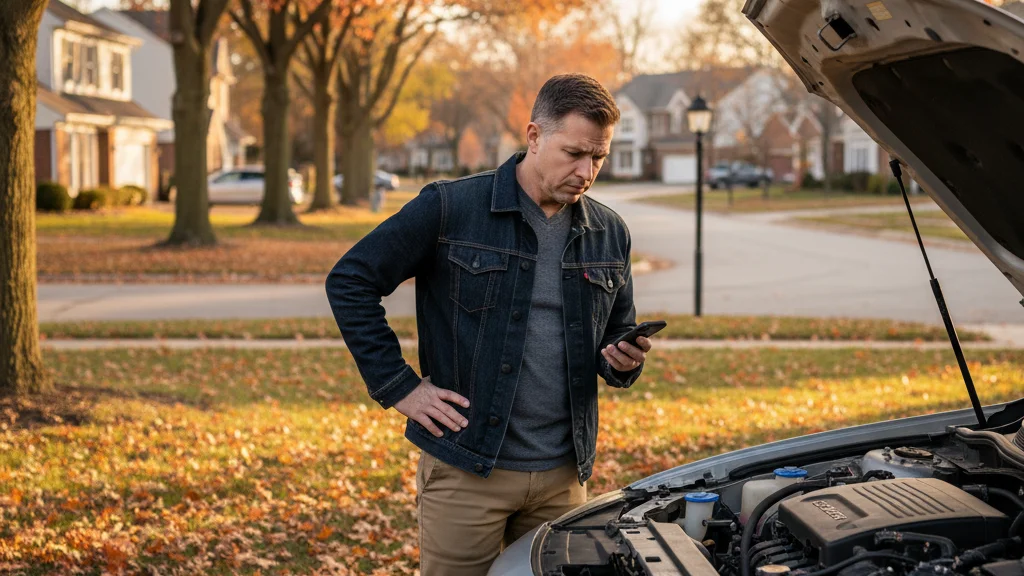
If you bought or leased a new car in Ohio and it keeps breaking down despite multiple repair attempts, you may have a lemon. Ohio’s lemon law exists to protect consumers like you, and understanding how it works is the first step toward getting the compensation you deserve.
Think your car might be a lemon? Take our free 60-Second Lemon Law Assessment™ or call 1-888-536-6671 to find out if you qualify. There is no fee unless we win your case.
This guide covers everything you need to know about the Ohio lemon law, from which vehicles qualify and what counts as a defect, to how to file a claim and what remedies are available. Whether your car has a stubborn transmission problem, recurring electrical issues, or a safety defect the dealer cannot fix, this guide will help you understand your rights and your next steps.
The Ohio lemon law is a state consumer protection statute found in Ohio Revised Code (ORC) Sections 1345.71 through 1345.78. It was enacted to protect consumers who purchase or lease new motor vehicles that turn out to have serious defects that cannot be timely repaired.
Under this law, if a manufacturer cannot repair a substantial defect after a reasonable number of attempts or amount of time, the manufacturer must either replace the vehicle or buy it back at full purchase price. The law puts the burden on the manufacturer to rebut the presumption, not on you, the consumer.
The Ohio lemon law applies specifically to problems that are covered by the manufacturer’s written warranty. It does not cover damage caused by accidents, neglect, unauthorized modifications, or normal wear and tear.
The Ohio lemon law covers a broad range of vehicles, as long as they are purchased or leased as new in the state of Ohio. Qualifying vehicles include:
Leased vehicles are fully covered. If you lease rather than buy, you have the same lemon law protections as an owner. This is an important right that many Ohio consumers do not realize they have.
The Ohio lemon law applies to noncommercial motor vehicles. Vehicles purchased primarily for business or commercial use may not qualify under other warranty or contract laws.
Ohio’s lemon law protection period begins on the date of delivery and lasts for the first 12 months or the first 18,000 miles, whichever comes first.
This means your vehicle’s defect must first appear during this window for the state lemon law to apply. However, there is an important nuance: even if the problem is discovered late in the protection period and repairs extend beyond the 12-month or 18,000-mile mark, you are still covered as long as the defect was first reported within the protection window.
If your vehicle’s defect appeared after the coverage period, do not assume you have no options. The federal Magnuson-Moss Warranty Act provides additional protections for any vehicle still under the manufacturer’s warranty, regardless of mileage or time limits. This federal law is a powerful tool that extends your rights well beyond the state lemon law’s coverage period.
Under ORC 1345.71, a qualifying defect (called a “nonconformity”) is defined as:
Any defect or condition that substantially impairs the use, value, or safety of a motor vehicle to the consumer and does not conform to the express warranty of the manufacturer or distributor.
This is a broad standard that covers a wide range of problems. Common defects that may qualify include:
The defect does not have to be life-threatening to qualify. Any condition that substantially affects how you use, enjoy, or rely on your vehicle can meet the standard.
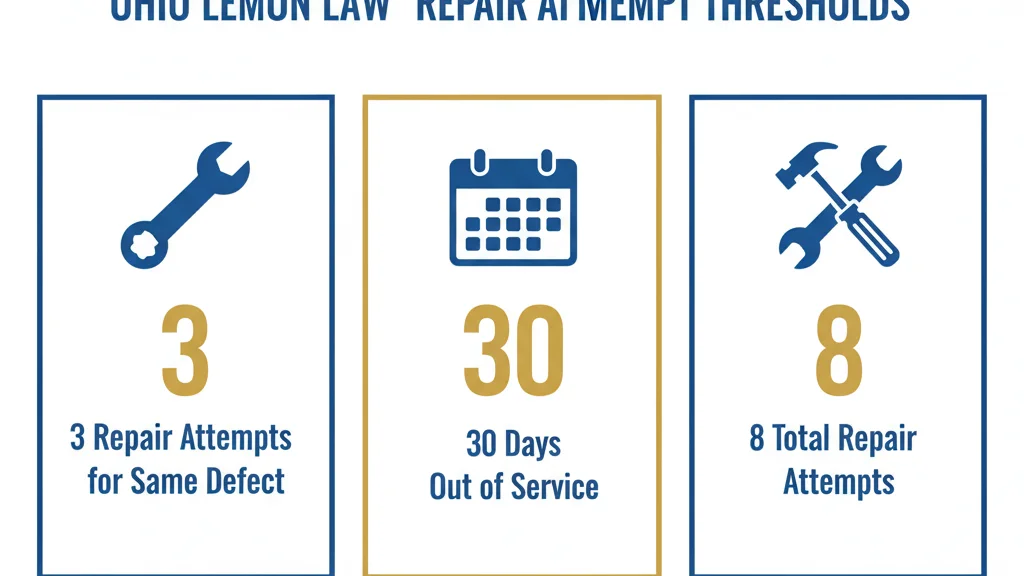
Before you can pursue a lemon law claim, the manufacturer must be given a reasonable opportunity to fix the problem. Under Ohio law, a “reasonable number of repair attempts” is generally established when any of the following conditions are met:
These are known as the “presumption thresholds.” Once you meet any one of these standards, Ohio law presumes that the manufacturer has had a reasonable chance to fix the problem and failed.
Send a written letter (certified mail is recommended) directly to the manufacturer’s customer service or legal department, describing the defect and the repair history.
Many consumers make the mistake of only communicating with the dealership. While the dealer performs the repairs, the manufacturer is the party legally responsible under the lemon law. Documenting your communication with the manufacturer strengthens your claim.
If the manufacturer cannot fix the defect after a reasonable number of attempts or amount of time, Ohio’s lemon law gives you three potential remedies:
The manufacturer must repurchase the vehicle at its full purchase price, which includes:
The manufacturer may NOT deduct a reasonable use allowance based on the mileage you drove before the first repair attempt for the defect in Ohio.
Instead of a buyback, you can request a comparable replacement vehicle of the same make and model (or a reasonably equivalent vehicle if the exact model is unavailable).
In many non-qualifying state lemon law cases, a negotiated cash settlement is reached without going through formal arbitration or court. This is a common outcome. Settlements typically include cash compensation for diminished value, loss of use, and inconvenience, inclusive of attorney’s fees and costs.
At Kahn & Associates, most settle without going to court and many cases resolve in 60 – 90 days or less.
One of the most significant developments in Ohio lemon law history is the case of Royster v. Toyota Motor Sales, U.S.A., Inc. (2001), 92 Ohio St.3d 327. This landmark case was handled by Craig A Kahn (founder of Kahn & Associates) and his team and eventually reached the Ohio Supreme Court, where it fundamentally strengthened consumer protections for Ohio vehicle owners.
The consumer in the Royster case had a new Toyota with persistent defects that kept the vehicle in the shop for more than 30 cumulative days. Toyota argued that the presumption of a lemon should not automatically apply because they eventually fixed the vehicle and tried to limit consumers’ ability to use the 30-day out-of-service presumption.
The Ohio Supreme Court ruled in favor of the consumer, establishing that when a vehicle has been out of service for 30 or more days due to warranty repairs, a legal presumption is created that the manufacturer has had a reasonable opportunity to fix the problem. This means the burden shifts to the manufacturer to prove the vehicle is not a lemon, rather than the consumer having to prove that it is. Toyota owners dealing with RAV4 or Tacoma defects can find specific guidance in our Toyota lemon law article.
The Royster decision is now cited by attorneys across the country. It ensures that Ohio consumers are not forced to endure endless repair attempts while manufacturers delay and deny. If your car has been in the shop for a combined 30 days or more, you have strong legal footing under this precedent.
Filing a lemon law claim in Ohio does not have to be complicated, especially with experienced legal guidance. For a broader overview of how the lemon law works across all states, see our complete guide. Here is the Ohio-specific process:
From the first sign of trouble, keep detailed records:
Take your vehicle to an authorized dealer for repair. Make sure the defect is documented on the repair order. Each visit counts toward the repair attempt thresholds described above.
After meeting the repair attempt threshold (three attempts for the same defect, or 30 days out of service), send a certified letter to the manufacturer notifying them that the vehicle qualifies as a lemon and requesting a refund, replacement, or settlement.
Ohio requires that if a manufacturer has an approved arbitration program, you must attempt arbitration before filing a lawsuit. These programs are informal, free, and faster than court proceedings. However, the arbitration decision is not binding on you. If you are unsatisfied with the result, you can still file a lawsuit.
While you can navigate the process on your own, working with an attorney who specializes in lemon law significantly increases your chances of a favorable outcome. Under Ohio state lemon law, the manufacturer is required to pay your attorney’s fees if your claim is successful at trial, so there is no out-of-pocket cost to you.
At Kahn & Associates, we offer a free 60-Second Lemon Law Assessment™ that quickly determines whether your vehicle qualifies. Call us at 1-888-536-6671 or fill out our online form. There is no fee unless we win your case.

Ohio’s state lemon law generally does not apply to used vehicles. It is designed specifically for new motor vehicles purchased or leased in Ohio. However, if you purchased a used vehicle that still had an active manufacturer’s warranty when the defect occurred, you may have a claim under the federal Magnuson-Moss Warranty Act. This federal law provides warranty protections regardless of whether the vehicle was purchased new or used.
Yes. Ohio’s lemon law explicitly covers motorcycles, as well as passenger cars, trucks, SUVs, vans, and recreational vehicles. The same repair attempt requirements and remedies apply.
Under Ohio law, you generally have up to five years from the date of purchase to file a lemon law claim. However, acting sooner is always better. The longer you wait, the harder it may be to gather evidence and the more mileage you may put on your vehicle cutting against the argument the use has been impaired. For a detailed breakdown of lemon law statute of limitations deadlines across all states we serve, see our complete guide.
Not with us. Ohio’s lemon law and the federal Magnuson-Moss Warranty Act both contain fee-shifting provisions that can require the manufacturer to pay your attorney’s fees and costs when your claim is successful. At Kahn & Associates, we handle every case on a pure contingency basis: No Recovery, No Fee. You pay nothing unless we win.
Dealers sometimes dismiss persistent problems as “normal operating characteristics.” If you believe the issue substantially impairs the use, value, or safety of your vehicle, do not accept this answer. Get a second opinion if possible, and consult with a lemon law attorney who can evaluate whether your situation qualifies. A defect does not have to be dramatic to qualify. Even recurring issues that the dealer considers “minor” can meet the legal standard under state or federal law.
Absolutely. Under ORC 1345.71, a “consumer” includes any lessee in a contractual arrangement for 30 days or more. Leased vehicles receive the same lemon law protections as purchased vehicles.
Ready to find out if your vehicle qualifies? Get your free 60-Second Lemon Law Assessment™ now, or call 1-888-536-6671. Our experienced team will review your case at no cost and with no obligation.
While you technically can pursue a lemon law claim on your own, having an experienced attorney on your side makes a significant difference. Here is why:
Craig A. Kahn, founder of Kahn & Associates, literally wrote the book on lemon law: Service Required: The Uncensored Truth About Lawyers and The Lemon Law. He and his team handled the Royster v. Toyota case, which ultimately went before the Ohio Supreme Court and has dedicated nearly three decades exclusively to protecting consumers with defective vehicles. If you are in the Cleveland area, visit our dedicated lemon law attorney Cleveland Ohio page to learn how we serve not only Northeast Ohio consumers, but consumers statewide in Ohio and other state.
If your vehicle qualifies, you have nothing to lose by getting a professional evaluation. Take our free 60-Second Lemon Law Assessment™ today, or call 1-888-536-6671. We serve consumers throughout Ohio, and no office visit is required.
Lemon Law Protections in Your State: Florida Lemon Law, Michigan Lemon Law, North Carolina Lemon Law, Pennsylvania Lemon Law
*Disclaimer: The information contained in this Website is provided for informational purposes only, and should not be construed as offering legal advice, or creating an attorney client relationship between the reader and the author. While we aim for accuracy, the law is constantly changing and we make no guarantees regarding the completeness or timeliness of the information. You should not act or refrain from acting on the basis of any content included in this Website without seeking appropriate legal advice about your individual facts and circumstances from an attorney licensed in your state.
To see if you qualify, fill out the form below or call us at 1-888-536-6671 – No Office Visit Needed!

I had a great experience with Kahn & Associates! They made the process of dealing with an extremely frustrating lemon situation painless. They have very quick response times and everyone I dealt with was very friendly and helpful. Would definitely recommend!
Kahn and Associates did an awesome job with our lemon law case! We were getting nowhere with VW Customer Service and decided to hire an attorney who specialized with lemon law cases. We couldn’t be happier with the outcome. We were able to get a full refund on our lemon VW Atlas.
What a great experience! I was on the fence about hiring an attorney for my ongoing automotive issues and continued frustration with the manufacturer. It was a very simple process and I am very grateful Kahn and Associates for helping get me a settlement!
Real Honest attorneys!!! They are the real deal! I went back and forth with them and they explained to me every step and my rights under the law! I give them 5 stars because I won!!! Yes and my check is coming to me much sooner than I thought! I was stuck ! I own a brand new car and the dealer was giving me a hard time !

This page has been written, edited, and reviewed by a team of legal writers following our comprehensive editorial guidelines. This page was approved by Attorney Craig A. Kahn, who has more than 20 years of legal experience in lemon law.
That sinking feeling you get when you realize the car you just bought is a lemon is awful. It’s a frustra...
Honda Lemon Law Help for Repeat Warranty Repairs The second or third repair visit is often when frustratio...
Most law firms will tell you they can handle a claim against a big automaker. But how many have taken Toyot...

Stuck with a defective car in Ohio? State Lemon Laws protect you. Get a refund, replacement, or cash settlement. Learn your rights today!

Florida Lemon Laws cover new and used vehicles. If your car’s a lemon, you deserve compensation. Let us help you fight for justice!

Michigan’s Lemon Law protects you from faulty vehicles. Don’t settle for endless repairs—claim your refund or replacement now.

North Carolina Lemon Laws ensure defective vehicles are replaced or refunded. Know your rights and take action today!

Pennsylvania Lemon Law covers new cars with repeated issues. Get the compensation you deserve. Click to learn more!
To see if you qualify, fill out the form below or call us at 1-888-536-6671 – No Office Visit Needed!

The Truth About Attorney’s Fees in Lemon Law Cases Learn more
*Disclaimer: The information contained in this Website is provided for informational purposes only, and should not be construed as offering legal advice, or creating an attorney client relationship between the reader and the author. While we aim for accuracy, the law is constantly changing and we make no guarantees regarding the completeness or timeliness of the information. You should not act or refrain from acting on the basis of any content included in this Website without seeking appropriate legal advice about your individual facts and circumstances from an attorney licensed in your state.

 Message Us
  Call Us