
Have A Case? Call Us
1 888-536-6671
60 Second Lemon Law Assessment™
60 Second Lemon Law Assessment™

Think your car might be a lemon? Take our free 60-Second Lemon Law Assessment or call 1-888-536-6671 to find out.
If you are dealing with a vehicle that keeps breaking down despite multiple repair attempts, you are not alone. Thousands of consumers every year find themselves stuck with cars, trucks, and SUVs that simply do not work as promised. The good news is that state and federal laws exist specifically to protect you.
Lemon laws are consumer protection statutes that require manufacturers to buy back or replace vehicles with substantial defects that cannot be fixed within a reasonable number of repair attempts or amount of time. After nearly 30 years of practicing lemon law exclusively, I have seen firsthand how these laws level the playing field between consumers and billion-dollar automakers.
This guide explains exactly how the lemon law works, who qualifies, and what you can expect from the process.
Lemon laws are state-level consumer protection laws designed to help people who purchase or lease defective vehicles. Every state has its own version of the lemon law, and there is also a federal law called the Magnuson-Moss Warranty Act that provides additional protection.
The core principle is straightforward: if a manufacturer sells you a vehicle with a substantial defect and cannot fix it within a reasonable number of attempts or amount of time, they must either replace the vehicle or refund your money.
Here is what most lemon laws require:
Most state lemon laws cover new vehicles purchased or leased within that state. Some states, like Ohio and Florida, also extend certain protections to used vehicles under specific circumstances.
Qualification depends on your state, your vehicle, and the nature of the defect. While requirements vary, here are the general criteria:
Vehicle Requirements:
Defect Requirements:
Documentation Requirements:
If you are unsure whether your situation qualifies, the fastest way to find out is through a free case evaluation.
Understanding the process removes much of the uncertainty. Here is how a typical lemon law case unfolds:
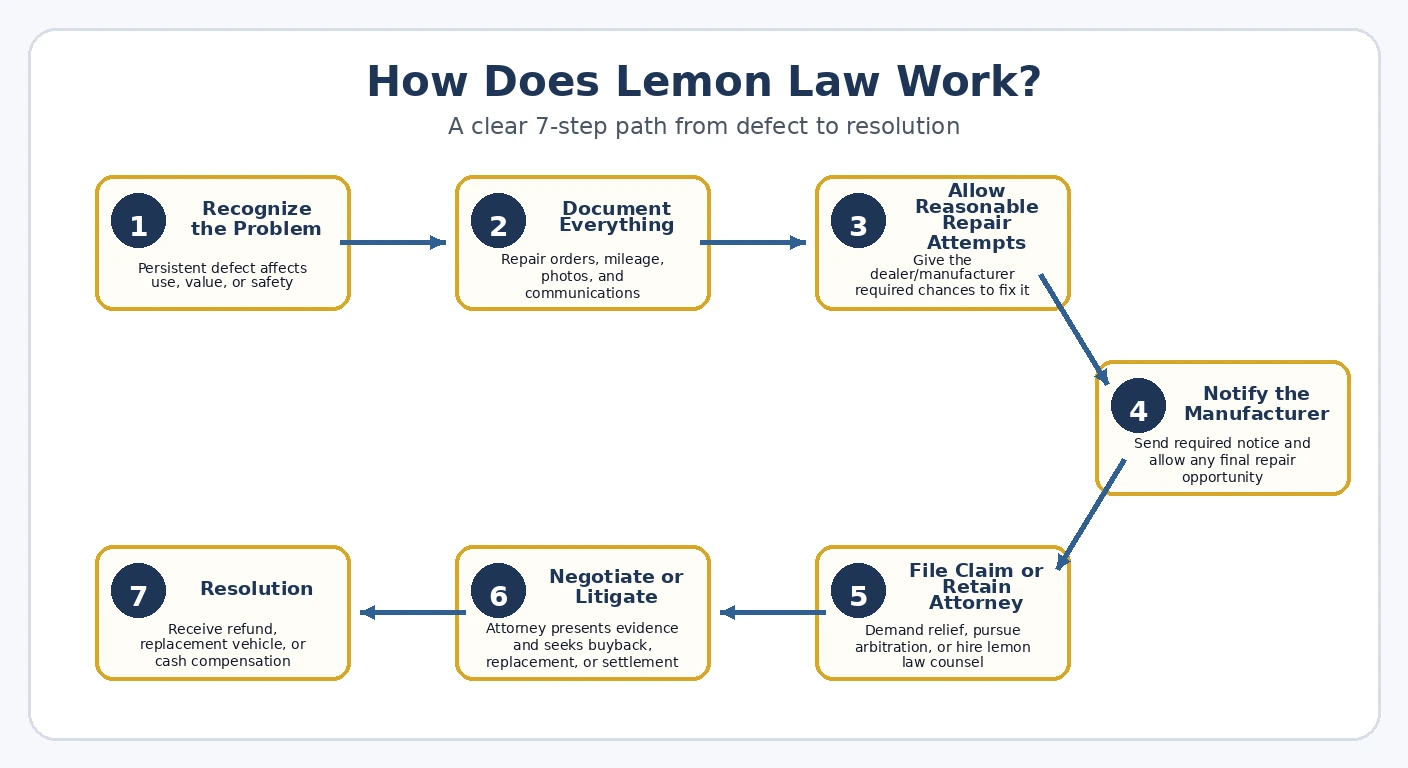
The process begins when you notice a persistent defect in your vehicle. Common qualifying defects include, but are not limited to:
Documentation is the backbone of any lemon law case. From the very first repair visit, you should:
Most states require you to give the manufacturer a reasonable number of chances to fix the defect. While the exact number varies by state, the general thresholds are:
Some states require you to send formal written notice to the manufacturer before filing a claim and allow the manufacturer a final opportunity to repair. This “final opportunity to repair” letter puts the manufacturer on notice that you intend to pursue your lemon law rights if the vehicle is not fixed.
At this point, you have two options:
The second option is almost always better, and here is why: under most lemon laws, if you win, the manufacturer pays your attorney’s fees. That means hiring a lawyer costs you nothing out of pocket. Your attorney negotiates directly with the manufacturer’s legal team, which typically results in faster and more favorable outcomes.
Most lemon law cases settle without filing a lawsuit or going to trial. Your attorney will present the evidence, including all repair records, correspondence, and expert opinions if needed, and negotiate a resolution with the manufacturer.
Typical resolutions include:
At Kahn & Associates, the vast majority of our cases resolve through negotiation prior to filing a lawsuit, and most are completed within 60 to 120 days.
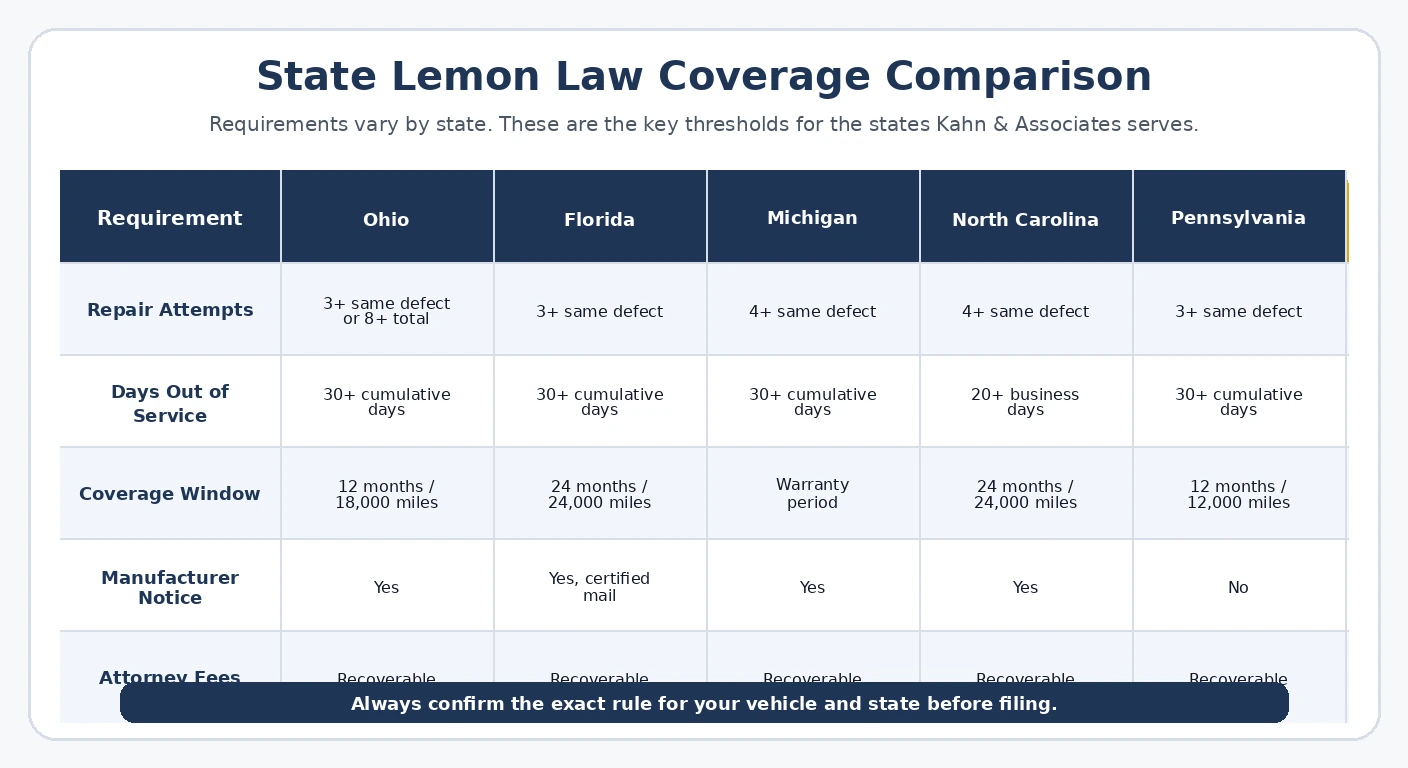
Lemon law requirements vary significantly from state to state. Here is how the five states we serve compare:
| Requirement | Ohio | Florida | Michigan | North Carolina | Pennsylvania |
|---|---|---|---|---|---|
| Repair Attempts Required | 3+ same defect or 8+ total | 3+ same defect | 4+ same defect | 4+ same defect | 3+ same defect |
| Days Out of Service | 30+ cumulative days | 30+ cumulative days | 30+ cumulative days | 20+ business days | 30+ cumulative days |
| Coverage Window | 12 months / 18,000 miles | 24 months / 24,000 miles | Warranty period | 24 months / 24,000 miles | 12 months / 12,000 miles |
| Vehicles Covered | New passenger vehicles | New motor vehicles | New motor vehicles | New motor vehicles | New motor vehicles |
| Manufacturer Notice Required | Yes | Yes (via certified mail) | Yes | Yes | No |
| Attorney Fees Recoverable | Yes | Yes | Yes | Yes | Yes |
For detailed information about your state’s specific requirements, visit our state-by-state lemon law guides.
When state lemon laws do not apply, whether because the vehicle is used, out of the state’s coverage window, or does not meet other criteria, the federal Magnuson-Moss Warranty Act may still provide protection.
The Magnuson-Moss Act protects consumers who purchased products (including vehicles) that came with a written warranty. Key differences from state lemon laws:
This federal law is particularly valuable for consumers whose vehicles fall outside their state’s lemon law window but still had active warranties during the repair period.
Not every vehicle problem qualifies under the lemon law. The defect must be substantial, meaning it genuinely impairs the vehicle’s use, value, or safety. Here are examples:
Qualifying Defects:
Non-Qualifying Issues:
If you are not sure whether your vehicle’s problem qualifies, our frequently asked lemon law questions page covers many common scenarios. You can also get a definitive answer through our free case evaluation.
Lemon law remedies are designed to make you whole. Depending on your state and the specifics of your case, you may be entitled to:
The manufacturer may deduct a “reasonable use allowance” from a buyback, depending on the state. Your attorney will negotiate to minimize this deduction.
For a deeper look at the buyback process specifically, see our guide on how the lemon law buyback works.
Not sure if your vehicle qualifies? Call 1-888-536-6671 or take our free 60-Second Lemon Law Assessment for a fast, no-obligation answer.
While you can technically file a lemon law claim on your own, the odds improve dramatically with experienced legal representation. Here is why:
Manufacturers have legal teams. They know the law inside and out and will use every technicality to deny or minimize your claim. An experienced lemon law attorney levels the playing field.
It costs you nothing. Under both state lemon laws and the federal Magnuson-Moss Act, prevailing consumers can recover their attorney fees from the manufacturer. At Kahn & Associates, we work on a pure contingency basis: if we do not win, you do not pay.
Faster resolutions. Cases with attorney representation typically resolve faser. Without an attorney, the process can drag on for months or even years.
Higher recoveries. Attorneys know what your case is worth and will not settle for less than you deserve. Consumers who represent themselves often accept lowball offers because they do not know what is fair.
Since 1996 and as of the date of this article, Kahn & Associates has recovered over $65 million for more than 13,000 clients across Ohio, Florida, Michigan, North Carolina, and Pennsylvania. Our landmark victory in Royster v. Toyota Motor Sales before the Ohio Supreme Court established precedent that still protects consumers today.
The process can take approximately 60-120 days from demand to resolution, though complex cases and certain manufacturers and other factors may make it take longer. If the case does not settle pre-suit and you have to file a lawsuit, the court process may take six months to a year or more depending on the court.
Most state lemon laws primarily cover new vehicles, but the federal Magnuson-Moss Warranty Act covers any vehicle that was under warranty when the defect occurred, regardless of whether it was purchased new or used. Visit our guide on lemon law for used cars for more details.
In most cases, no. Lemon law attorneys typically work on contingency, and both state and federal lemon laws allow prevailing consumers to recover attorney fees from the manufacturer. At Kahn & Associates, our promise is simple: No Recovery, No Fees or Costs.
Yes. Unless the vehicle has a safety defect that makes it dangerous to operate, you can continue driving it throughout the case. In fact, keeping the vehicle in your possession helps preserve evidence.
This is more common than you might think. Even if the dealer cannot duplicate the issue, your documented complaints, repair visits, and descriptions of the problem can still support your case. The law focuses on the number of repair attempts, not whether the dealer admitted to finding the defect.
No. A lemon law claim is a consumer protection action against the manufacturer, not a debt proceeding. It does not appear on your credit report and has no impact on your credit score.
*Disclaimer: The information contained in this Website is provided for informational purposes only, and should not be construed as offering legal advice, or creating an attorney client relationship between the reader and the author. While we aim for accuracy, the law is constantly changing and we make no guarantees regarding the completeness or timeliness of the information. You should not act or refrain from acting on the basis of any content included in this Website without seeking appropriate legal advice about your individual facts and circumstances from an attorney licensed in your state.
To see if you qualify, fill out the form below or call us at 1-888-536-6671 – No Office Visit Needed!

I had a great experience with Kahn & Associates! They made the process of dealing with an extremely frustrating lemon situation painless. They have very quick response times and everyone I dealt with was very friendly and helpful. Would definitely recommend!
Kahn and Associates did an awesome job with our lemon law case! We were getting nowhere with VW Customer Service and decided to hire an attorney who specialized with lemon law cases. We couldn’t be happier with the outcome. We were able to get a full refund on our lemon VW Atlas.
What a great experience! I was on the fence about hiring an attorney for my ongoing automotive issues and continued frustration with the manufacturer. It was a very simple process and I am very grateful Kahn and Associates for helping get me a settlement!
Real Honest attorneys!!! They are the real deal! I went back and forth with them and they explained to me every step and my rights under the law! I give them 5 stars because I won!!! Yes and my check is coming to me much sooner than I thought! I was stuck ! I own a brand new car and the dealer was giving me a hard time !

This page has been written, edited, and reviewed by a team of legal writers following our comprehensive editorial guidelines. This page was approved by Attorney Craig A. Kahn, who has more than 20 years of legal experience in lemon law.
It’s a sinking feeling: your new car is already having problems the dealership can’t seem to fi...
Mazda Lemon Law: CX-5, CX-9, Mazda3, and Mazda6 Defect Claims If your Mazda has been back to the dealershi...
The true cost of auto dealer fraud is rarely just the sticker price. It’s the unexpected repair bills for...

Stuck with a defective car in Ohio? State Lemon Laws protect you. Get a refund, replacement, or cash settlement. Learn your rights today!

Florida Lemon Laws cover new and used vehicles. If your car’s a lemon, you deserve compensation. Let us help you fight for justice!

Michigan’s Lemon Law protects you from faulty vehicles. Don’t settle for endless repairs—claim your refund or replacement now.

North Carolina Lemon Laws ensure defective vehicles are replaced or refunded. Know your rights and take action today!

Pennsylvania Lemon Law covers new cars with repeated issues. Get the compensation you deserve. Click to learn more!
To see if you qualify, fill out the form below or call us at 1-888-536-6671 – No Office Visit Needed!

The Truth About Attorney’s Fees in Lemon Law Cases Learn more
*Disclaimer: The information contained in this Website is provided for informational purposes only, and should not be construed as offering legal advice, or creating an attorney client relationship between the reader and the author. While we aim for accuracy, the law is constantly changing and we make no guarantees regarding the completeness or timeliness of the information. You should not act or refrain from acting on the basis of any content included in this Website without seeking appropriate legal advice about your individual facts and circumstances from an attorney licensed in your state.

 Message Us
  Call Us