
Have A Case? Call Us
1 888-536-6671
60 Second Lemon Law Assessment™
60 Second Lemon Law Assessment™
by Kahn & Associates - July 3rd, 2026
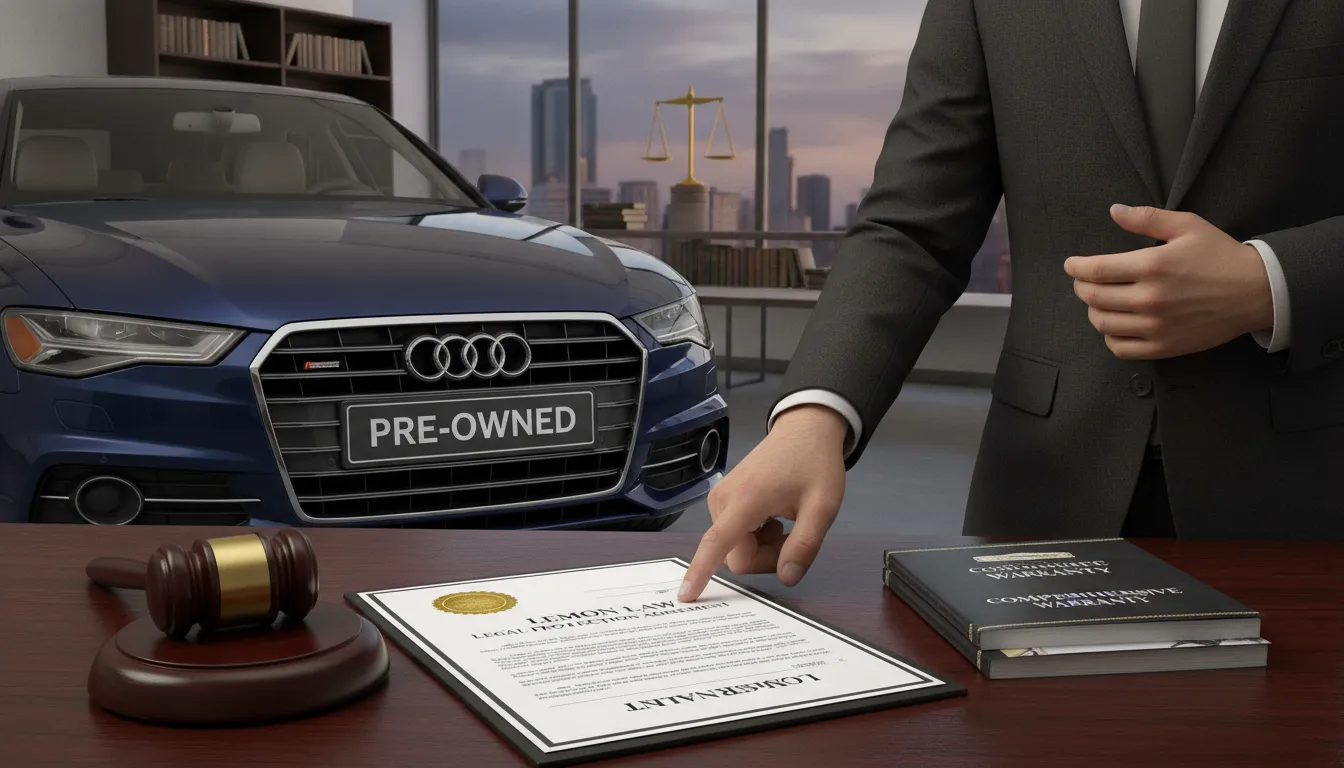
Engine failure in a certified pre-owned vehicle can turn a smart purchase into a source of daily stress. While many people think lemon laws only cover new cars, a manufacturer warranty often provides the same legal protections for used vehicles. You do not have to keep a defective car just because it is not brand new.
Get your 60-Second Lemon Law Assessment to find out if your CPO vehicle qualifies for legal protection. If the manufacturer cannot fix a covered defect after a reasonable number of attempts, you may be entitled to a refund or replacement.
The certified pre-owned lemon law applies to used cars still covered by the original manufacturer’s warranty. A manufacturer-backed CPO certification triggers the same legal standards that protect new-car buyers when a major defect arises. This coverage does not extend to third-party service contracts or dealer-only warranties.
Understanding your consumer rights starts with knowing how the law classifies your vehicle. Many owners confuse standard used cars with those carrying a factory seal of approval.
A certified pre-owned (CPO) car is a used vehicle that passes a manufacturer-set inspection. Unlike a standard used car, a CPO vehicle undergoes a multi-point check of the engine, brakes, transmission, and safety systems. The manufacturer certifies that the car meets its quality standards and backs that certification with a warranty.
Factory-trained technicians inspect CPO vehicles from top to bottom before they go on sale. They check for hidden damage, verify service records, and replace worn parts. This process filters out vehicles with significant past problems or poor maintenance histories. While these inspections are thorough, they do not guarantee the car will never develop a defect after purchase.
A genuine CPO car carries a warranty from the manufacturer, not a third-party administrator or the dealer alone. This distinction matters for lemon law protection for used cars. When the manufacturer stands behind the warranty, state lemon laws and the federal Magnuson-Moss Warranty Act may apply if a covered defect cannot be fixed after a reasonable number of repair attempts.
Third-party service contracts, by contrast, function more like repair insurance. They rarely trigger lemon law rights. Knowing which type of warranty you have is the first step toward protecting your rights.
Yes, a certified pre-owned car can qualify for lemon law protection. The controlling factor is whether the vehicle remains under the original manufacturer’s warranty at the time the defect is reported. The CPO sticker alone does not create legal rights.
A CPO car qualifies for lemon law protection when the original manufacturer warranty is still active, the defect substantially impairs use or safety, and the consumer gives the manufacturer a reasonable number of repair attempts. Without an active factory warranty, even a fully certified vehicle may not trigger legal remedies.
The manufacturer’s original warranty is the key that unlocks lemon law coverage for CPO vehicles. Many buyers assume the “certified” label grants full new-car rights. This is true only when the factory warranty is still in effect. CPO programs typically include the remainder of the original warranty plus an additional CPO-specific warranty from the manufacturer. Lemon law analysis focuses on the original warranty period.
If a defect emerges while the manufacturer warranty is active, you are in a stronger legal position. If the warranty has already expired, the CPO certification alone will not create lemon law eligibility. State-specific used vehicle laws vary, but the active warranty requirement is consistent across most jurisdictions.
Check your warranty status by contacting any authorized dealer with your Vehicle Identification Number (VIN). The dealer can confirm when the original warranty started, when it expires, and what it covers. You must report any defect to the dealer while the warranty is still active. Reporting issues after expiration may forfeit your claim.
Save every repair order from each service visit. These documents prove that you gave the manufacturer a fair opportunity to fix the defect. If the dealer says the car is “fine” but the problem persists, do not accept that response. A certified vehicle should perform reliably. If it does not and the factory warranty is still active, you may have a lemon law claim. Take the 60-Second Lemon Law Assessment to learn whether your situation qualifies.
Three conditions determine whether a CPO vehicle qualifies for lemon law remedies. These requirements mirror the standards that apply to new vehicles, with the added condition of an active manufacturer warranty.
The defect must arise while the original manufacturer warranty is in effect. State lemon laws focus on who provides the warranty, not the name of the certification program. A true CPO car carries a written warranty from the manufacturer, which is what triggers federal and state lemon law protections.
Not every flaw qualifies as a lemon. The defect must substantially impair the vehicle’s use, value, or safety. Engine failure, transmission slippage, and brake system defects typically meet this standard. Minor trim issues or cosmetic flaws generally do not.
The law gives the manufacturer a fair chance to fix the vehicle. In most states, this means three or four repair attempts for the same issue, or the vehicle being out of service for 30 or more cumulative days. Keeping every service record is essential to proving this element.
State lemon laws are powerful, but they often impose age or mileage restrictions. If your vehicle exceeds those limits, the Magnuson-Moss Warranty Act provides a federal safety net. Because a CPO vehicle carries a manufacturer’s written warranty, it falls within the scope of this federal law.
The Magnuson-Moss Warranty Act protects CPO owners by enforcing the terms of any written warranty from the manufacturer. Unlike some state laws that only cover new cars, this federal law applies whenever a written warranty exists, regardless of the vehicle’s age or mileage. If the manufacturer fails to repair a covered defect, the consumer may seek a refund, replacement, or monetary damages.
The choice between state and federal claims depends on your specific circumstances. State laws often provide clearer qualification thresholds, while federal law offers broader applicability for used vehicles still under warranty.
| Feature | State Lemon Law | Federal (Magnuson-Moss) |
|---|---|---|
| Coverage Basis | Vehicle age or mileage limits | Existence of a written warranty |
| Used Car Inclusion | Varies by state | Included if under written warranty |
| Attorney Fees | Must be paid if consumer wins | May be awarded at court discretion |
| Repair Attempts Required | Specific count (typically 3-4) | Reasonable number of attempts |
| Available Remedies | Refund or replacement vehicle | Refund, replacement, or damages |
When a manufacturer breaches a CPO warranty, federal law provides several forms of relief. You may recover the full purchase price, receive a replacement vehicle, or obtain cash damages for the diminished value. These remedies help ensure that consumers are not left without recourse when a manufacturer fails to honor its warranty obligations.
If your certified pre-owned vehicle requires repeated repairs, act quickly to preserve your legal rights. Many owners do not realize that lemon law protections for used cars cover CPO vehicles when the original warranty is still active. Follow these steps to build a strong case.
Start a log on the first visit. Record the date you dropped the vehicle off, the date it was returned, the symptoms reported, and the work performed. If the vehicle spends more time at the dealership than is reasonable, that time counts toward the legal threshold for a lemon law claim.
Send defect reports by email or certified mail to both the dealer and the manufacturer. Verbal complaints are difficult to prove. Written correspondence creates a clear record of the issue and your attempts to get it resolved.
If your certified pre-owned vehicle has spent more time at the dealership than is reasonable, you need a legal team that understands both state and federal warranty law. Kahn and Associates has represented vehicle owners since 1996. We focus exclusively on lemon law and manufacturer warranty claims. Our team handles cases involving used cars that remain under the manufacturer’s original warranty.
We serve consumers in Ohio, Florida, Michigan, North Carolina, and Pennsylvania through remote representation. You do not need to visit an office. We manage everything by phone, email, and mail. Our firm has helped more than 13,000 vehicle owners and recovered over $65 million. Learn more About the Firm.
We know a defective vehicle creates significant stress. Our goal is to hold the manufacturer accountable so you can move forward. We handle all communications with the manufacturer and build every case using the full scope of state and federal lemon law protections.
Our firm achieved a landmark victory in Royster v. Toyota at the Supreme Court of Ohio. Craig Kahn signed up the case and handled it at the trial-court and first appellate-court levels. Once it reached the Supreme Court of Ohio, his team of attorneys, including the Ohio Attorney General, secured the win. That case helped define consumer warranty protections in Ohio.
We maintain a 97% win rate including cases filed in court. Successful claims may result in a full refund of the purchase price, a replacement vehicle, or cash compensation. We work on a contingency fee basis, which means you pay nothing out of pocket unless we win. Start your 60-Second Lemon Law Assessment to find out if your CPO vehicle qualifies.
Yes. Many state lemon laws cover certified pre-owned cars as long as they remain under the original manufacturer’s warranty. The CPO certification signals a manufacturer-backed warranty, which is the trigger for legal protection. If the vehicle has a substantial defect that the manufacturer cannot fix after a reasonable number of attempts, the owner may qualify for a refund or replacement.
A manufacturer warranty is a written promise from the automaker to repair defects. State lemon laws require this type of warranty for a claim to be valid. An extended warranty is often a third-party service contract that does not carry the same legal weight. CPO vehicles qualify for lemon law protection only when the manufacturer’s original warranty remains active.
You need written repair orders from every service visit showing dates, symptoms, and work performed. You also need your original purchase contract, the warranty document, and any written correspondence with the dealer or manufacturer about the defect. These records establish that you reported the issue while the warranty was active and gave the manufacturer a reasonable opportunity to fix it.
Generally no. Lemon law protections depend on the defect arising while the manufacturer warranty is active. If the original warranty has expired, the CPO certification alone does not create a lemon law claim. However, the Magnuson-Moss Warranty Act may still apply if the CPO warranty itself is a written warranty from the manufacturer, so it is worth discussing your specific situation with an attorney.
Most states require three or four repair attempts for the same substantial defect, or the vehicle being out of service for 30 or more cumulative days. The specific number depends on your state’s lemon law. Some states have lower thresholds for safety-related defects. Keeping a log of every repair visit is essential for meeting these requirements.
A defective certified pre-owned vehicle is stressful, but you have legal options. If your CPO car is still under the manufacturer’s warranty and has recurring problems, you may be entitled to a refund or replacement at no cost to you. Kahn and Associates handles lemon law cases on a contingency basis, meaning you pay nothing unless we win.
Take the 60-Second Lemon Law Assessment to find out if your CPO vehicle qualifies. Most cases are resolved within 30 to 60 days once legal work begins.
*Disclaimer: The information contained in this Website is provided for informational purposes only, and should not be construed as offering legal advice, or creating an attorney client relationship between the reader and the author. While we aim for accuracy, the law is constantly changing and we make no guarantees regarding the completeness or timeliness of the information. You should not act or refrain from acting on the basis of any content included in this Website without seeking appropriate legal advice about your individual facts and circumstances from an attorney licensed in your state.
To see if you qualify, fill out the form below or call us at 1-888-536-6671 – No Office Visit Needed!

I had a great experience with Kahn & Associates! They made the process of dealing with an extremely frustrating lemon situation painless. They have very quick response times and everyone I dealt with was very friendly and helpful. Would definitely recommend!
Kahn and Associates did an awesome job with our lemon law case! We were getting nowhere with VW Customer Service and decided to hire an attorney who specialized with lemon law cases. We couldn’t be happier with the outcome. We were able to get a full refund on our lemon VW Atlas.
What a great experience! I was on the fence about hiring an attorney for my ongoing automotive issues and continued frustration with the manufacturer. It was a very simple process and I am very grateful Kahn and Associates for helping get me a settlement!
Real Honest attorneys!!! They are the real deal! I went back and forth with them and they explained to me every step and my rights under the law! I give them 5 stars because I won!!! Yes and my check is coming to me much sooner than I thought! I was stuck ! I own a brand new car and the dealer was giving me a hard time !

This page has been written, edited, and reviewed by a team of legal writers following our comprehensive editorial guidelines. This page was approved by Attorney Craig A. Kahn, who has more than 20 years of legal experience in lemon law.
A prolonged parts delay may support a lemon law or warranty claim when it causes an unreasonable amount of ...
When a vehicle keeps returning to the dealership for the same warranty problem, the paperwork from each vis...
That sinking feeling when your new car’s check engine light comes on again is a unique kind of frustratio...

Stuck with a defective car in Ohio? State Lemon Laws protect you. Get a refund, replacement, or cash settlement. Learn your rights today!

Florida Lemon Laws cover new and used vehicles. If your car’s a lemon, you deserve compensation. Let us help you fight for justice!

Michigan’s Lemon Law protects you from faulty vehicles. Don’t settle for endless repairs—claim your refund or replacement now.

North Carolina Lemon Laws ensure defective vehicles are replaced or refunded. Know your rights and take action today!

Pennsylvania Lemon Law covers new cars with repeated issues. Get the compensation you deserve. Click to learn more!
To see if you qualify, fill out the form below or call us at 1-888-536-6671 – No Office Visit Needed!

The Truth About Attorney’s Fees in Lemon Law Cases Learn more
*Disclaimer: The information contained in this Website is provided for informational purposes only, and should not be construed as offering legal advice, or creating an attorney client relationship between the reader and the author. While we aim for accuracy, the law is constantly changing and we make no guarantees regarding the completeness or timeliness of the information. You should not act or refrain from acting on the basis of any content included in this Website without seeking appropriate legal advice about your individual facts and circumstances from an attorney licensed in your state.

 Message Us
  Call Us