
Have A Case? Call Us
1 888-536-6671
60 Second Lemon Law Assessment™
60 Second Lemon Law Assessment™
by Kahn & Associates - May 11th, 2026
Bought a new vehicle in North Carolina that keeps breaking down despite repeated repairs? North Carolina’s lemon law, known as the New Motor Vehicles Warranties Act, gives you the legal right to demand a refund or replacement. This guide covers everything you need to know about qualifying, filing a claim, and protecting yourself.
Take our free 60-Second Lemon Law Assessment™ or call 1-888-536-6671 to find out if your vehicle qualifies. There is no cost to you.
North Carolina’s lemon law is officially called the North Carolina New Motor Vehicles Warranties Act (N.C. Gen. Stat. § 20-351 through § 20-351.10). Enacted in 1987, this consumer protection statute exists to hold manufacturers accountable when they sell vehicles with serious defects not timely repaired.
The law is straightforward in its purpose: if a manufacturer sells you a new vehicle with a substantial problem and cannot fix it after a reasonable number of attempts, they must make it right. That means either replacing your vehicle with a comparable one or refunding your full purchase price.
Many North Carolina consumers have no idea these protections exist. Manufacturers and dealerships certainly are not going to volunteer this information. Understanding your rights under the NC lemon law is the first step toward getting the compensation you deserve.
Not every vehicle qualifies for protection under North Carolina’s lemon law. Here is what the statute covers and does not cover:
Covered vehicles:
Not covered:
One critical point many people miss: the law applies only to the first purchaser or lessee of a new vehicle. If you bought the vehicle secondhand, the state lemon law does not apply directly, but you may still have strong legal options through the Magnuson-Moss Warranty Act and other federal protections.
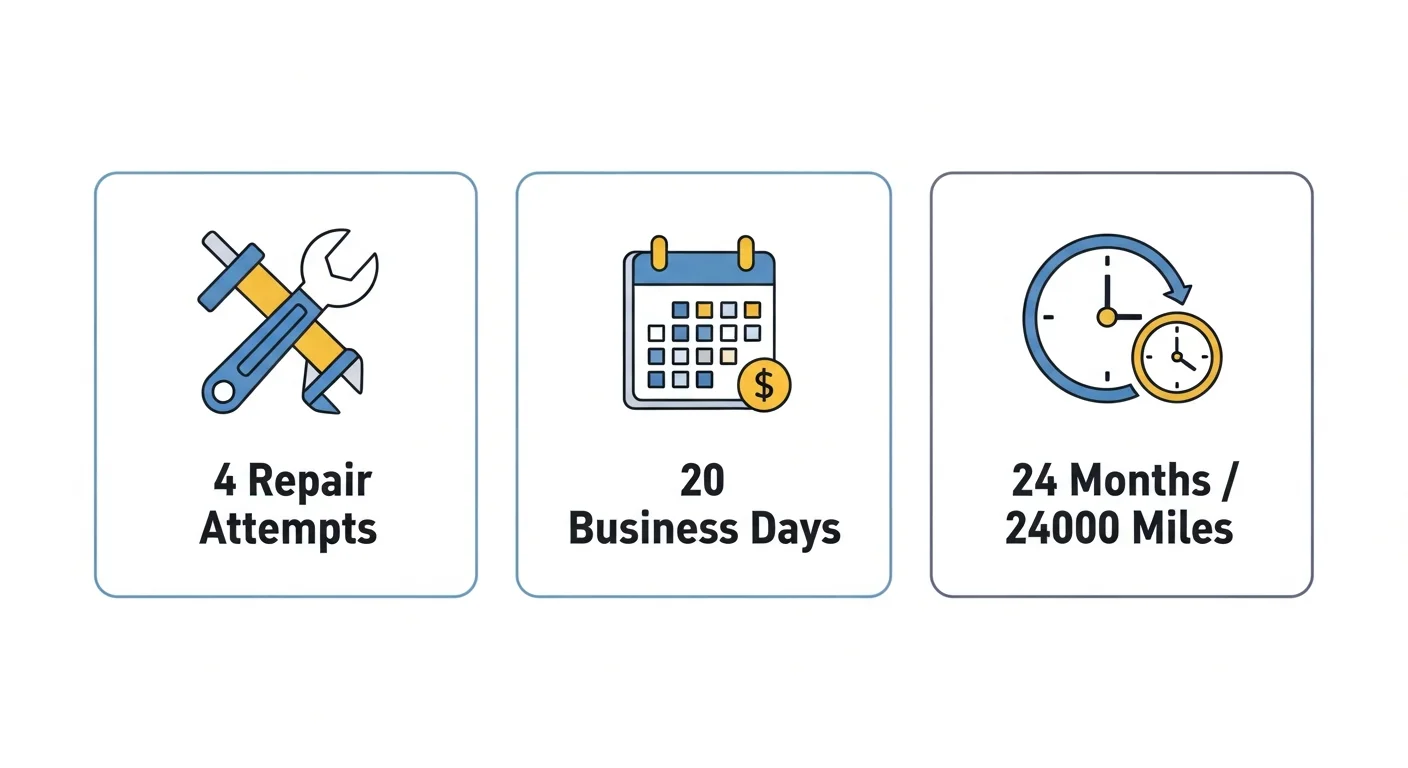
Your 4 repair attempts to the vehicle must be within the first 24 months or 24,000 miles from the date of original delivery, whichever comes first. Or 20 or more business day out of service during an one year period of the warranty. The defect must also fall within the scope of the manufacturer’s express warranty.
The defect must substantially impair the use, market value, or safety of your vehicle. This is an important distinction. Minor cosmetic issues or normal wear items generally do not qualify. The kinds of problems that typically meet this standard include:
Under North Carolina law, you have met the threshold for a lemon law claim when any one of these conditions is true:
The 20-business-day rule is particularly important and often overlooked. If your vehicle has been in the shop for various warranty issues totaling at least 20 business days within any 12-month stretch during the warranty, you may have a valid claim even if no single problem required four separate repair attempts.
Before pursuing a lemon law claim in North Carolina, you are generally required to notify the manufacturer directly about the defect and/or you intention to file suit. This can be done through a letter sent to the manufacturer’s customer service or warranty department, which should have a tracking mechanism to show proof it was received.
Keeping detailed written records of every repair visit, including dates, mileage, descriptions of the problem, and what work was performed, strengthens your claim significantly.
If your vehicle qualifies as a lemon under North Carolina law, the manufacturer must provide one of two remedies:
The manufacturer repurchases your vehicle for the full purchase price, including:
The manufacturer is allowed to deduct a reasonable use allowance based on the mileage you put on the vehicle before up to the third repair attempt or 20th day out of service for the qualifying defect. This is typically calculated using a formula specified in the statute.
For a detailed look at how lemon law buybacks work across all of our states, see our comprehensive buyback guide.
Instead of a refund, you can request a comparable replacement vehicle of the same year, make, model, and equipment. The manufacturer must also cover any incidental costs associated with the replacement.
This is one of the most important aspects of North Carolina’s lemon law and similar consumer protection statutes: the manufacturer may be required to pay your attorney’s fees if you prevail. This means there is no financial risk to you for hiring a lemon law attorney in North Carolina. A qualified attorney works on your behalf at zero out-of-pocket cost.
To learn what typical lemon law settlements look like and what factors affect the amount, read our settlement guide.
Not every defective vehicle falls neatly within North Carolina’s state lemon law. Maybe you bought a used vehicle, or your mileage exceeds 24,000. Maybe the vehicle is just outside the 24-month window.
That does not mean you are without options.
The Magnuson-Moss Warranty Act is a federal law that protects consumers who purchase any product with a written warranty, including vehicles. Unlike state lemon laws, the federal statute:
If the manufacturer made promises under their warranty and failed to fulfill them after reasonable repair attempts, you may have a valid federal claim. At Kahn & Associates, we regularly pursue federal claims for consumers whose vehicles fall outside the strict boundaries of state lemon laws.
North Carolina’s version of the Uniform Commercial Code provides additional protections through implied warranties of merchantability and fitness. These can apply even when express warranty coverage has expired in certain circumstances.

From the moment you notice a problem, start building your case file:
Send written notice to the manufacturer’s regional or national customer service department describing the defect and your repair history. Many manufacturers have specific addresses for warranty complaints listed in your owner’s manual.
While the dealership often communicates with the manufacturer on your behalf during repairs, sending your own written notice creates an independent record that you gave the manufacturer a fair opportunity to resolve the problem.
Before accepting any offer from the manufacturer or entering an informal dispute process, talk to a lemon law attorney who understands North Carolina’s lemon laws and case law. An experienced attorney can:
At Kahn & Associates, our free 60-Second Lemon Law Assessment™ gives you an immediate preliminary evaluation of your case. We have helped more than 13,000 consumers recover over $65 million from vehicle manufacturers since 1996 as of the date of this article.
Most lemon law cases are resolved through negotiation between your attorney and the manufacturer’s legal team. The vast majority of cases settle without going to court. When manufacturers know they are facing an experienced lemon law firm with a track record of winning, they typically prefer to settle rather than risk a trial.
If the manufacturer refuses to offer fair compensation, you can file a lemon law claim in court. Under state law, you may be entitled to additional damages if the manufacturer acted in bad faith.
Myth: “The dealer has to agree that my car is a lemon.”
The dealership does not decide whether your vehicle is a lemon. Lemon law determinations are based on the statutory criteria (repair attempts, days out of service) and are resolved between you (through your attorney) and the manufacturer.
Myth: “I have to go through the manufacturer’s arbitration program first.”
North Carolina does require you to participate in the manufacturer’s informal dispute process before filing a legal claim under certain circumstances. While manufacturers may offer arbitration, you are not obligated to accept the award win or lose, and having an attorney evaluate your options first is strongly recommended.
Myth: “The lemon law only covers the engine and transmission issues.”
The NC lemon law covers any defect that substantially impairs the use, value, or safety of the vehicle. This includes electrical systems, brakes, steering, safety features, persistent warning lights, water leaks, and many other issues.
Myth: “Hiring a lawyer is too expensive.”
Most lemon law attorneys work on a contingency basis, meaning they are only paid if you win or settle. Additionally, state and federal lemon laws provide a mechanism for manufacturers to pay your attorney fees and costs when a case is won or settled. If your case is not successful at our firm, you owe nothing.
Yes. North Carolina enacted the New Motor Vehicles Warranties Act (N.C. Gen. Stat. § 20-351 et seq.) in 1987. It protects consumers who purchase or lease new vehicles with substantial defects not timely repaired within the first 24 months or 24,000 miles of ownership.
The state lemon law applies only to new vehicles. However, used car buyers may have strong protections under the federal Magnuson-Moss Warranty Act if the vehicle was still under a manufacturer’s warranty or certified pre-owned warranty when the defects occurred. Our attorneys regularly handle these federal claims.
Under North Carolina law, four or more repair attempts for the same defect during any 12-month period within the coverage window, or 20 or more cumulative business days out of service for repairs during any 12-month period, establishes the threshold for a lemon law claim.
No. Most lemon law attorneys work on a contingency basis, meaning they are only paid if you win or settle. Additionally, state and federal lemon laws provide a mechanism for manufacturers to pay your attorney fees and costs when a case is won or settled. If your case is not successful at our firm, you owe nothing.
Yes you can continue using your vehicle normally, unless the defect makes the car unsafe to drive. However, the more you use your care the strong the manufacturer’s argument may be that the vehicle is not substantially impaired.
The process can take approximately 60-120 days from demand to resolution, though complex cases and certain manufacturers and other factors may make it take longer. If the case does not settle pre-suit and you have to file a lawsuit, the court process may take six months to a year or more depending on the court.
If you are driving a new vehicle in North Carolina that has been in the shop repeatedly for the same substantial problem, or has spent 20 or more business days being repaired in any 12-month period, you likely have a valid lemon law claim.
Do not wait for the manufacturer to do the right thing on their own. The law is on your side, and an experienced attorney can ensure you receive every dollar you are owed, without costing you anything out-of-pocket.
Get your free case evaluation today. Call Kahn & Associates at 1-888-536-6671 or take our 60-Second Lemon Law Assessment™ to find out if your vehicle qualifies. With 29 years of exclusive lemon law practice, more than $65 million recovered for clients as of the date of this article and counting, and very high out-of-court settlement rate, we have the experience and track record to fight for you.
*Disclaimer: The information contained in this Website is provided for informational purposes only, and should not be construed as offering legal advice, or creating an attorney client relationship between the reader and the author. While we aim for accuracy, the law is constantly changing and we make no guarantees regarding the completeness or timeliness of the information. You should not act or refrain from acting on the basis of any content included in this Website without seeking appropriate legal advice about your individual facts and circumstances from an attorney licensed in your state.
To see if you qualify, fill out the form below or call us at 1-888-536-6671 – No Office Visit Needed!

I had a great experience with Kahn & Associates! They made the process of dealing with an extremely frustrating lemon situation painless. They have very quick response times and everyone I dealt with was very friendly and helpful. Would definitely recommend!
Kahn and Associates did an awesome job with our lemon law case! We were getting nowhere with VW Customer Service and decided to hire an attorney who specialized with lemon law cases. We couldn’t be happier with the outcome. We were able to get a full refund on our lemon VW Atlas.
What a great experience! I was on the fence about hiring an attorney for my ongoing automotive issues and continued frustration with the manufacturer. It was a very simple process and I am very grateful Kahn and Associates for helping get me a settlement!
Real Honest attorneys!!! They are the real deal! I went back and forth with them and they explained to me every step and my rights under the law! I give them 5 stars because I won!!! Yes and my check is coming to me much sooner than I thought! I was stuck ! I own a brand new car and the dealer was giving me a hard time !

This page has been written, edited, and reviewed by a team of legal writers following our comprehensive editorial guidelines. This page was approved by Attorney Craig A. Kahn, who has more than 20 years of legal experience in lemon law.
Three dealership visits for the same BMW defect can signal more than bad luck. Repeated warranty repairs ma...
Hyundai ranks among the most popular vehicle brands in the United States, with the Tucson and Sonata consis...
A prolonged parts delay may support a lemon law or warranty claim when it causes an unreasonable amount of ...

Stuck with a defective car in Ohio? State Lemon Laws protect you. Get a refund, replacement, or cash settlement. Learn your rights today!

Florida Lemon Laws cover new and used vehicles. If your car’s a lemon, you deserve compensation. Let us help you fight for justice!

Michigan’s Lemon Law protects you from faulty vehicles. Don’t settle for endless repairs—claim your refund or replacement now.

North Carolina Lemon Laws ensure defective vehicles are replaced or refunded. Know your rights and take action today!

Pennsylvania Lemon Law covers new cars with repeated issues. Get the compensation you deserve. Click to learn more!
To see if you qualify, fill out the form below or call us at 1-888-536-6671 – No Office Visit Needed!

The Truth About Attorney’s Fees in Lemon Law Cases Learn more
*Disclaimer: The information contained in this Website is provided for informational purposes only, and should not be construed as offering legal advice, or creating an attorney client relationship between the reader and the author. While we aim for accuracy, the law is constantly changing and we make no guarantees regarding the completeness or timeliness of the information. You should not act or refrain from acting on the basis of any content included in this Website without seeking appropriate legal advice about your individual facts and circumstances from an attorney licensed in your state.

 Message Us
  Call Us