
Have A Case? Call Us
1 888-536-6671
60 Second Lemon Law Assessment™
60 Second Lemon Law Assessment™

One of the first questions we hear from vehicle owners dealing with a defective car or truck is, “How much is my lemon law case actually worth?” It is a fair question, and one that deserves a straightforward answer.
After nearly 30 years of handling lemon law cases across Ohio, Florida, Michigan, North Carolina, and Pennsylvania, I can tell you this: lemon law settlement amounts vary significantly based on your vehicle, the defect, your state’s laws, and how you pursue your claim. But most consumers who qualify for protection walk away with meaningful compensation, often without ever stepping into a courtroom.
This guide breaks down what typical lemon law settlement amounts look like, the different types of settlements available, and the factors that determine how much you could receive.
Key Takeaways:
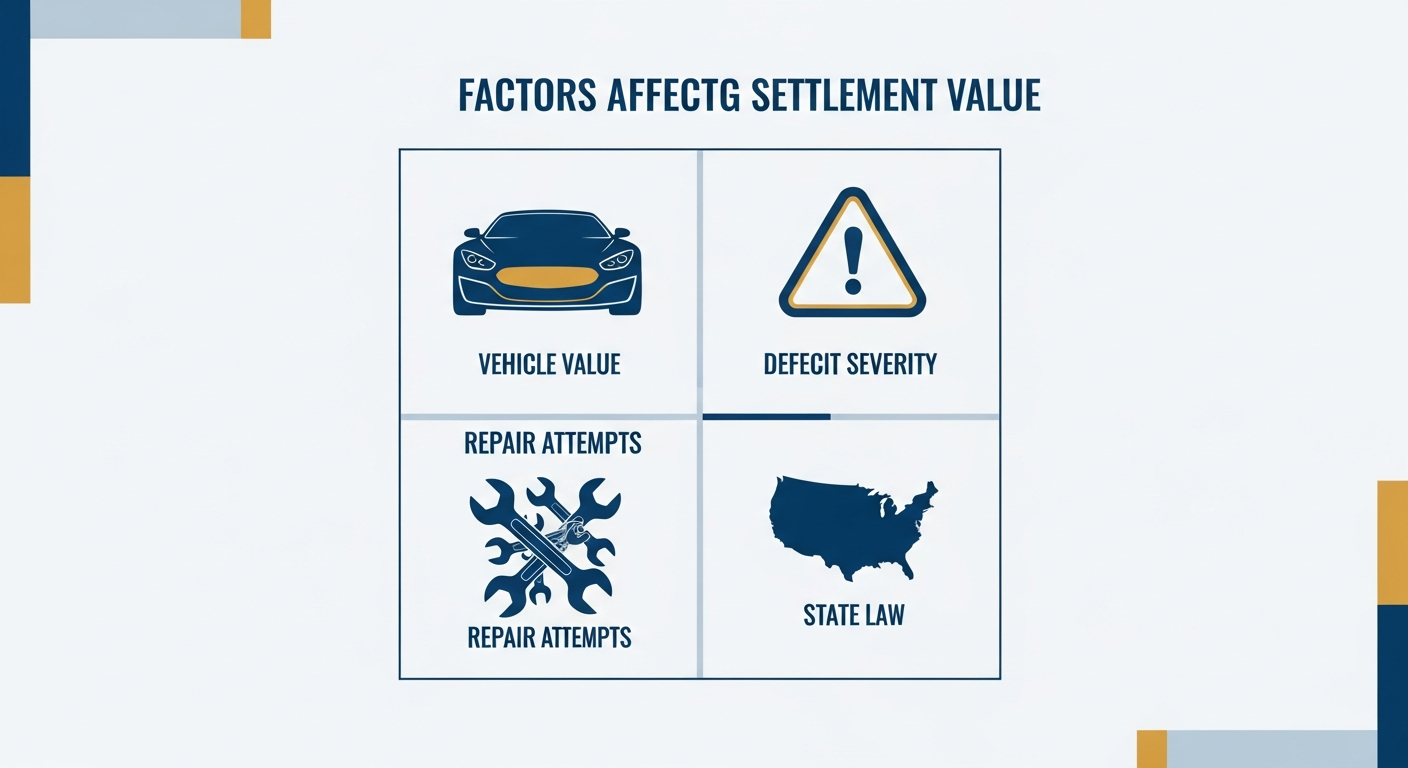
There is no single formula that applies to every lemon law case. Settlement amounts are shaped by several interconnected factors that are unique to your situation.
The value of your vehicle is the starting point for any settlement calculation. A $55,000 truck with persistent transmission problems will naturally yield a larger settlement than a $22,000 sedan with an electrical glitch. Your original purchase price, including taxes, registration fees, and dealer-installed accessories, forms the baseline.
If you are still making payments, a buy back settlement must also address your remaining loan balance. In a buyback, the manufacturer is typically required to pay off your loan in addition to refunding amounts you have already paid.
Not all vehicle defects carry the same weight in settlement negotiations. Defects are generally evaluated on a spectrum:
A vehicle with a safety defect that the manufacturer could not fix after multiple attempts will almost always command a higher settlement than one with a recurring but non-dangerous issue.
State lemon laws set specific thresholds that trigger protection. While the exact numbers vary by state, the general pattern is consistent: more repair attempts and more days without your vehicle strengthen your case and increase your potential settlement.
In Ohio, for example, the landmark case Royster v. Toyota Motor Sales that my team argued before the Ohio Supreme Court established that 30 or more cumulative days out of service, even if the vehicle was repaired, creates a presumption of lemon law relief. That legal precedent continues to protect Ohio consumers today.
Each state structures its protections differently, which directly affects settlement amounts:
For vehicles that fall outside strict state lemon law coverage, the federal Magnuson-Moss Warranty Act provides an additional layer of protection that can apply regardless of mileage or vehicle age, as long as the warranty was active when the defect occurred.
Understanding the three main settlement types helps you set realistic expectations for your case.
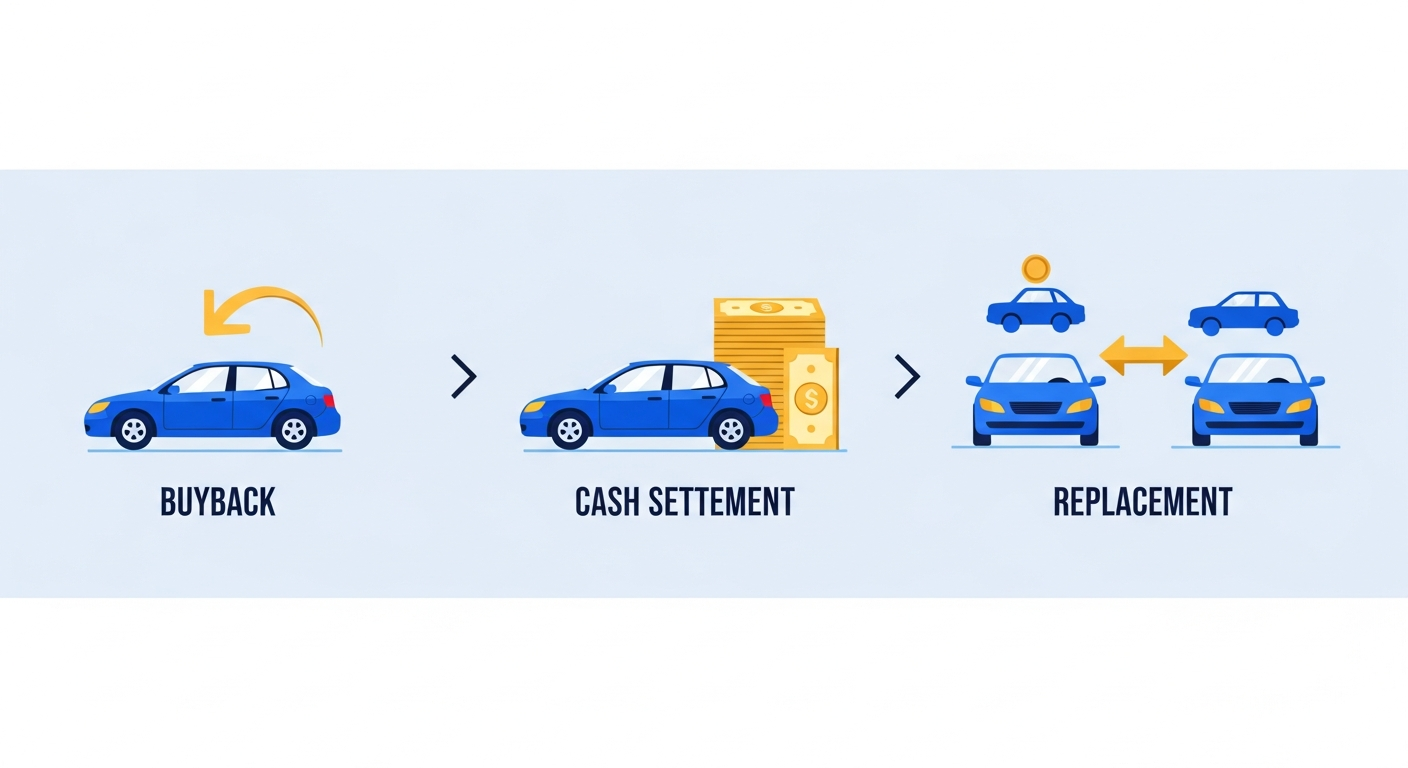
A buyback is the most common and often the most valuable type of lemon law settlement. The manufacturer repurchases your defective vehicle and compensates you for what you have paid.
What a buyback typically includes:
What is deducted:
A “reasonable use allowance” based on the mileage you drove. This is calculated using a formula that divides the miles driven by a set mileage limit (often 100,000 or 120,000 miles), then multiplied by the purchase price.
Example scenario: If you purchased a vehicle for $40,000 and drove 5,000 miles, with a 120,000-mile divisor, the use allowance would be approximately $1,667. Your buyback settlement before incidental costs would be roughly $38,333, plus reimbursement for taxes, registration, and any out-of-pocket expenses.
For a detailed walkthrough of the buyback process, including how the use allowance is calculated in each state, see our complete guide.
A cash-and-keep settlement means you retain ownership of your vehicle at the time of the settlement and receive a cash payment from the manufacturer. This option works well when the repairs do not qualify under the state lemon law, the defect has been eventually repaired or when you prefer to keep the vehicle despite its history. You can still sell or trade-in the vehicle at any time after the settlement.
Cash-and-keep amounts are negotiated based on:
Cash-and-keep settlements generally range from several thousand dollars to a significant percentage of the vehicle’s value, depending on the severity of the issues and the leverage your case provides in negotiations.
Some states require the manufacturer to provide a comparable replacement vehicle if requested by the consumer. The replacement must be substantially identical to the vehicle being returned, including the same make, model, year, and equipment. While less common than buybacks, this option lets you walk away with a working version of the vehicle you originally wanted.
Certain elements consistently lead to higher settlements. Understanding these can help you protect your claim from the start.
Detailed records of every repair visit, every conversation with the dealership, and every day you were without your vehicle directly support a larger settlement. Keep copies of all repair orders, correspondence, and receipts for related expenses like rental cars and towing.
Starting your claim while your vehicle is still under the manufacturer’s warranty strengthens your position significantly. Delays can complicate your case and potentially reduce what you are entitled to receive.
This is the single biggest factor that separates consumers who receive fair settlements from those who settle for less than they deserve. Manufacturers have teams of lawyers whose job is to minimize what they pay. An experienced lemon law attorney levels the playing field.
At Kahn & Associates, our attorney fees are paid by the manufacturer when we win your case, not by you. There are no upfront costs, no hourly fee bills, and no risk to you. If we do not recover compensation on your behalf, you pay nothing. We have successfully recovered over $65 million for more than 13,000 clients because we know exactly how to build cases that manufacturers take seriously as of the date of this article.
If your vehicle’s defect poses a safety risk, make sure this is clearly documented in your repair records. Safety-related defects not only strengthen your legal claim but also increase the urgency for manufacturers to resolve the case favorably.
The process can take approximately 60-120 days from demand to resolution, though complex cases and certain manufacturers and other factors may make it take longer. If the case does not settle pre-suit and you have to file a lawsuit, the court process may take six months to a year or more depending on the court.
The timeline depends largely on how quickly the manufacturer responds and whether the facts of your case clearly meet your state’s lemon law requirements. Working with an attorney who has established relationships with manufacturer legal teams often accelerates the process.
Settlement amounts depend on the number of qualified repairs or days out of service, your vehicle’s value, the defect, and your state’s laws. Buyback settlements return most or all of your purchase price minus a reasonable use allowance. Cash-and-keep settlements are negotiated based on diminished value and case strength. There is no universal average because every case involves different facts.
In most cases, the refund portion of a lemon law buyback settlement is not taxable because it is considered a return of your own money. However, amounts received for emotional distress or punitive damages may be taxable. Consult a tax professional for guidance specific to your situation.
Most lemon law attorneys work on a contingency basis, meaning they are only paid if you win or settle. Additionally, state and federal lemon laws provide a mechanism for manufacturers to pay your attorney fees and costs when a case is won or settled.
At Kahn & Associates, you never pay out of pocket. Our representation is on a pure contingency basis: no recovery, no fees or costs.
It depends on your state. Pennsylvania’s lemon law covers used vehicles purchased from a dealer. In other states, the federal Magnuson-Moss Warranty Act may protect you if your used vehicle was still under the manufacturer’s warranty when the defect occurred. Learn more about federal protections.
Be cautious about accepting a manufacturer’s initial offer without legal guidance. These offers are typically well below what you are entitled to receive. Manufacturers know that most consumers are unfamiliar with the full scope of their rights. An experienced attorney can evaluate whether the offer is fair or negotiate a significantly better outcome.
Our very high settlement rate reflects nearly three decades of case results. While past results do not guarantee future outcomes, this track record demonstrates our ability to build strong cases that manufacturers prefer to resolve rather than litigate. Every case is different, and we evaluate yours individually during a free case review.
If your vehicle has been in and out of the shop for the same problem, you may be entitled to significant compensation under your state’s lemon law. The only way to know for certain what your case is worth is to have it evaluated by an attorney who handles these cases every day.
At Kahn & Associates, we offer a free, no-obligation case review. Take our 60-Second Lemon Law Assessment or call us directly at 1-888-536-6671. We have been fighting for consumers with defective vehicles since 1996, and we are ready to fight for you.
Remember: you pay nothing unless we win. The manufacturer typically pays our fees when we recover compensation for you. That is our promise, and it has been for nearly 30 years.
*Disclaimer: The information contained in this Website is provided for informational purposes only, and should not be construed as offering legal advice, or creating an attorney client relationship between the reader and the author. While we aim for accuracy, the law is constantly changing and we make no guarantees regarding the completeness or timeliness of the information. You should not act or refrain from acting on the basis of any content included in this Website without seeking appropriate legal advice about your individual facts and circumstances from an attorney licensed in your state.
To see if you qualify, fill out the form below or call us at 1-888-536-6671 – No Office Visit Needed!

I had a great experience with Kahn & Associates! They made the process of dealing with an extremely frustrating lemon situation painless. They have very quick response times and everyone I dealt with was very friendly and helpful. Would definitely recommend!
Kahn and Associates did an awesome job with our lemon law case! We were getting nowhere with VW Customer Service and decided to hire an attorney who specialized with lemon law cases. We couldn’t be happier with the outcome. We were able to get a full refund on our lemon VW Atlas.
What a great experience! I was on the fence about hiring an attorney for my ongoing automotive issues and continued frustration with the manufacturer. It was a very simple process and I am very grateful Kahn and Associates for helping get me a settlement!
Real Honest attorneys!!! They are the real deal! I went back and forth with them and they explained to me every step and my rights under the law! I give them 5 stars because I won!!! Yes and my check is coming to me much sooner than I thought! I was stuck ! I own a brand new car and the dealer was giving me a hard time !

This page has been written, edited, and reviewed by a team of legal writers following our comprehensive editorial guidelines. This page was approved by Attorney Craig A. Kahn, who has more than 20 years of legal experience in lemon law.
If you bought or leased a new vehicle in Michigan and it keeps breaking down despite repeated trips to the ...
It’s a sinking feeling: your new car is already having problems the dealership can’t seem to fi...
If your new car keeps breaking down despite multiple trips to the dealership, you may be wondering how to f...

Stuck with a defective car in Ohio? State Lemon Laws protect you. Get a refund, replacement, or cash settlement. Learn your rights today!

Florida Lemon Laws cover new and used vehicles. If your car’s a lemon, you deserve compensation. Let us help you fight for justice!

Michigan’s Lemon Law protects you from faulty vehicles. Don’t settle for endless repairs—claim your refund or replacement now.

North Carolina Lemon Laws ensure defective vehicles are replaced or refunded. Know your rights and take action today!

Pennsylvania Lemon Law covers new cars with repeated issues. Get the compensation you deserve. Click to learn more!
To see if you qualify, fill out the form below or call us at 1-888-536-6671 – No Office Visit Needed!

The Truth About Attorney’s Fees in Lemon Law Cases Learn more
*Disclaimer: The information contained in this Website is provided for informational purposes only, and should not be construed as offering legal advice, or creating an attorney client relationship between the reader and the author. While we aim for accuracy, the law is constantly changing and we make no guarantees regarding the completeness or timeliness of the information. You should not act or refrain from acting on the basis of any content included in this Website without seeking appropriate legal advice about your individual facts and circumstances from an attorney licensed in your state.

 Message Us
  Call Us