
Have A Case? Call Us
1 888-536-6671
60 Second Lemon Law Assessment™
60 Second Lemon Law Assessment™
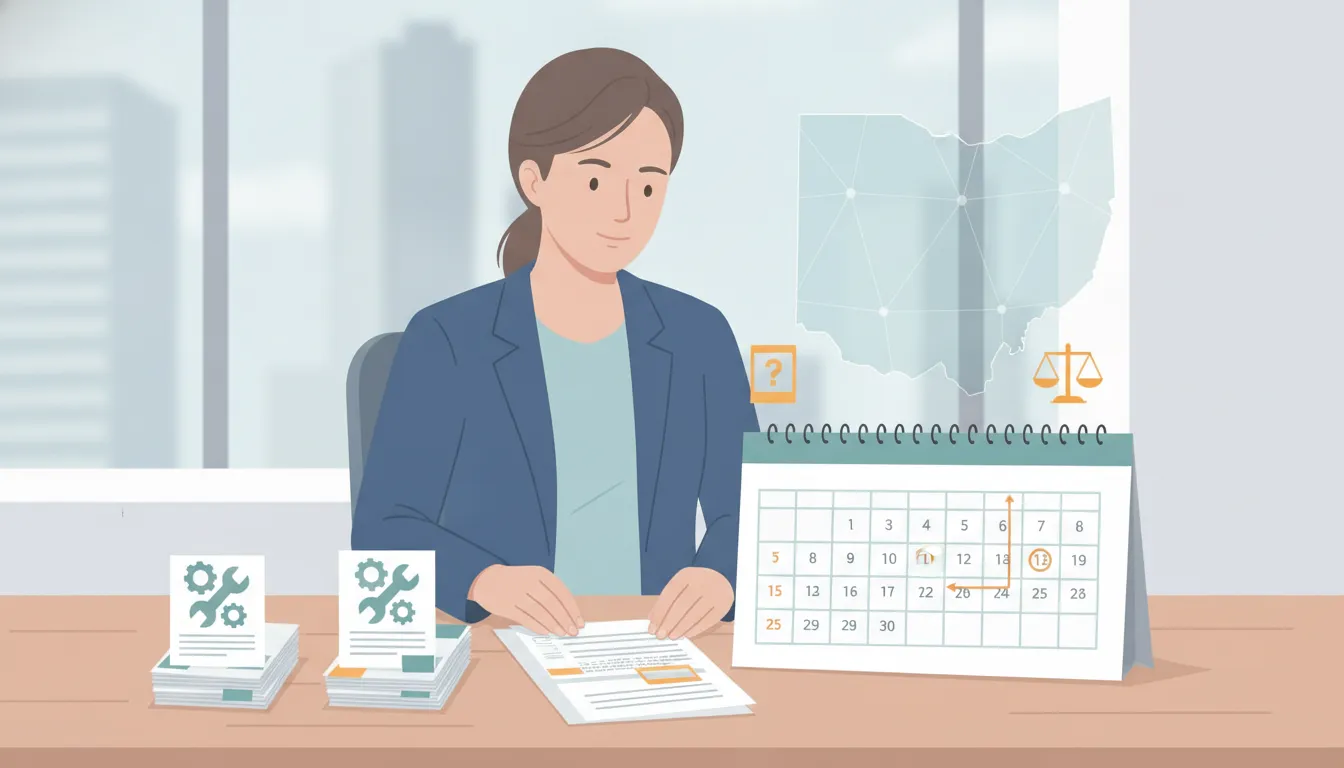
A missing repair date can weaken an otherwise well-documented warranty claim. A clear day-by-day record shows when your vehicle was unavailable, what the authorized dealer did, and how often the problem returned.
Request a free case assessment from Kahn & Associates, L.L.C. We have recovered more than $65 million for consumers and have a 97% win rate including cases filed in court. Complete the free case assessment form to discuss your repair timeline, or call the dynamic tracking number displayed in the site header. You pay no out-of-pocket fees or costs, win or lose.
Ohio lemon law out of service days are cumulative calendar days a vehicle is unavailable because of repair. They do not need to occur during one continuous dealership visit. Track every drop-off and pickup date, repair order number, mileage reading, reported defect, and message from the service department. Keep the original records with your timeline so an attorney can assess which days may count under the facts and applicable law.
This practical guide explains how to build that timeline, what documents to preserve, and what questions an attorney may ask during a case review.
Ohio law provides several ways to evaluate whether a manufacturer had a reasonable opportunity to repair a covered problem. One is based on the cumulative amount of time a vehicle is out of service by reason of repair. Under the statutory presumption, the total is 30 or more calendar days. A presumption can help support a claim, but it does not make every matter automatic. Coverage periods, warranty facts, the reason for each visit, and available proof all matter.
You do not need a single 30-day repair visit. Separate visits may add up. For example, a vehicle might spend eight days at an authorized dealer during one visit, 12 days during a later visit, and ten days during a third visit. Those stays total 30 calendar days even though the owner drove the vehicle between visits.
The time between repair visits does not count, but it does not erase earlier repair time. Keep every repair order in one chronology so the cumulative pattern remains visible.
A repair stay may include weekends and holidays because the measure concerns calendar days. If a vehicle remains unavailable at the dealership while it waits for diagnosis, authorization, or a part, document that fact. Do not assume every delay automatically counts. Preserve the dealer’s explanation so an attorney can evaluate it.
Not every day without your vehicle necessarily belongs in the legal count. Collision work, routine maintenance, or a voluntary pickup delay may raise different issues. Record the actual reason for each stay instead of labeling every unavailable day as lemon law time. The firm’s Ohio Lemon Law guide provides more context about coverage and possible remedies.
Build a working timeline that an attorney can compare with the underlying records. Your calculation is a factual organizing tool, not a final legal conclusion. Accuracy is more useful than an inflated total.
A repair order might show an open date, invoice date, close date, and pickup date. These may not match. Put each date in your timeline and identify its source. If a dealer says the vehicle was ready before you received notice, save the ready notice and any related messages. An attorney can then assess the conflict.
A spreadsheet or notebook can work well. Create columns for the visit number, dealer, drop-off date, ready date, pickup date, mileage, complaint, diagnosis, and supporting documents. Add a notes column for unclear details. Update it after every repair visit while events are fresh.
Your records should establish when the vehicle entered the shop, why it went there, what happened during the stay, and when it became available again. Preserve originals and store digital copies in a folder sorted by date.
| Record | What it can show | Why it helps |
|---|---|---|
| Repair order | Dates, mileage, complaint, diagnosis, and work | Connects a visit to the reported defect |
| Dealer messages | Status updates and ready notice | Clarifies the actual service timeline |
| Tow and loaner records | Tow date and loaner period | Supports dates when the vehicle was unavailable |
| Photos and videos | Warning lights or recurring symptoms | Preserves intermittent problems |
| Warranty papers | Coverage terms and manufacturer information | Helps assess applicable warranty rights |
| Personal chronology | Daily events and conversations | Identifies gaps that need supporting proof |
Check that the repair order accurately states your complaint, dates, mileage, and work performed. Keep the final invoice even when warranty work costs you nothing. A record that says the dealer could not duplicate the problem can still confirm the visit, complaint, mileage, and time at the shop.
If an important detail is wrong, ask the service department to correct it in writing. Keep both the original and corrected version. Do not alter the dealer’s record yourself.
Texts, emails, app messages, and voicemail files may show when parts were ordered, when a repair was delayed, or when the vehicle was ready. After a verbal conversation, send a short follow-up email stating the date, employee’s name, discussed problem, and next step. Invite corrections if your summary is inaccurate.
Write down each event tied to the defect. Include the date, mileage, person contacted, issue reported, and whether the vehicle could be used. Keep facts separate from assumptions. A clean chronology helps an attorney identify repeated problems, missing records, and important dates.
Many owners begin with incomplete files. Mark each gap instead of guessing. Then look for another dated record that can confirm what happened.
If an invoice lacks a pickup date, check dealer texts, emails, phone records, ride receipts, loaner agreements, and calendar entries. A ready notice may establish when the dealer finished the work, while a loaner return record may support the actual pickup date. Keep both if there is a difference.
Ask for parts-order dates, backorder notices, and messages showing when a part arrived. Note whether the vehicle stayed at the dealer or remained with you. These details help explain the delay without requiring you to speculate.
Put all repair visits in one timeline even if different authorized dealers performed the work. Use consistent terms for recurring symptoms. A single chronology makes it easier to see whether a problem returned and how long the vehicle was unavailable overall.
Request complete copies, technician notes, and available warranty claim records from the service department. Record the date of your request and any response. If a record remains unavailable, preserve emails or screenshots showing your attempt to obtain it.
An initial review usually begins with the vehicle, warranty, reported defects, and repair history. The goal is to understand the facts and determine what law may apply. Be ready to provide documents even if you think they are unimportant.
An attorney may ask when you delivered the vehicle, when the dealer said it was ready, and when you picked it up after every visit. They may compare repair orders against messages, towing records, and loaner agreements. Conflicting dates do not mean you should abandon the timeline. They show where closer review is needed.
Any possible claim and outcome depend on the specific facts, available records, warranty coverage, and applicable law. An initial assessment cannot promise a result.
Keep originals and create backups. Use clear file names that begin with the date. Followed by a short description such as “repair order” or “dealer ready text.” Do not discard duplicate-looking documents until an attorney has reviewed them because each may contain a different date or note.
Ask the dealer for complete repair orders, final invoices, technician notes, and warranty claim information. Make the request in writing and save the response. Continue updating the timeline if another repair visit occurs.
A well-organized timeline lets an attorney focus on the legal issues instead of first reconstructing basic dates. Kahn & Associates, L.L.C. represents consumers in manufacturer-warranty and lemon law matters. You can use the firm’s free case assessment to share your repair history and ask about possible next steps.
Before you decide what to do next, request a free case assessment. Kahn & Associates, L.L.C. has recovered more than $65 million for consumers and has a 97% win rate including cases filed in court. Complete the free case assessment form to share your repair history, or call the dynamic tracking number displayed in the site header. You pay no out-of-pocket fees or costs, win or lose.
No. The statutory presumption addresses a cumulative total of 30 or more calendar days out of service by reason of repair. Separate qualifying repair stays may add together. Which days count depends on the facts and applicable law.
Waiting time may matter when the vehicle remains unavailable for warranty repair. Preserve backorder notices, dealer messages, and records showing where the vehicle was located. An attorney can assess whether those days support a claim.
Ask the dealer to correct the record in writing. Keep the original, corrected copy, and messages about the request. Do not alter the original yourself. Other dated documents may help clarify the timeline.
Yes. Use appointment emails, service texts, towing receipts, loaner agreements, phone logs, and other dated records. Request the missing repair order and save proof of that request.
Consider a review when problems keep recurring, the vehicle remains unavailable for extended periods, or records contain conflicting dates. An attorney can assess the complete repair history under the facts and applicable law.
Organizing your records now can make important dates and service visits easier to confirm. A clear timeline helps explain what happened, when your vehicle was unavailable, and which documents support each period of downtime.
Request a free case assessment from Kahn & Associates to discuss your repair history, Ohio lemon law out of service days, and possible next steps.
*Disclaimer: The information contained in this Website is provided for informational purposes only, and should not be construed as offering legal advice, or creating an attorney client relationship between the reader and the author. While we aim for accuracy, the law is constantly changing and we make no guarantees regarding the completeness or timeliness of the information. You should not act or refrain from acting on the basis of any content included in this Website without seeking appropriate legal advice about your individual facts and circumstances from an attorney licensed in your state.
To see if you qualify, fill out the form below or call us at 1-888-536-6671 – No Office Visit Needed!

I had a great experience with Kahn & Associates! They made the process of dealing with an extremely frustrating lemon situation painless. They have very quick response times and everyone I dealt with was very friendly and helpful. Would definitely recommend!
Kahn and Associates did an awesome job with our lemon law case! We were getting nowhere with VW Customer Service and decided to hire an attorney who specialized with lemon law cases. We couldn’t be happier with the outcome. We were able to get a full refund on our lemon VW Atlas.
What a great experience! I was on the fence about hiring an attorney for my ongoing automotive issues and continued frustration with the manufacturer. It was a very simple process and I am very grateful Kahn and Associates for helping get me a settlement!
Real Honest attorneys!!! They are the real deal! I went back and forth with them and they explained to me every step and my rights under the law! I give them 5 stars because I won!!! Yes and my check is coming to me much sooner than I thought! I was stuck ! I own a brand new car and the dealer was giving me a hard time !

This page has been written, edited, and reviewed by a team of legal writers following our comprehensive editorial guidelines. This page was approved by Attorney Craig A. Kahn, who has more than 20 years of legal experience in lemon law.
When you realize your new car is a lemon, it’s easy to feel overwhelmed by a massive auto manufacturer. B...
Every mile you drive in a defective vehicle can affect your Florida lemon law buyback calculation. While yo...
It’s a sinking feeling: your new car is already having problems the dealership can’t seem to fi...

Stuck with a defective car in Ohio? State Lemon Laws protect you. Get a refund, replacement, or cash settlement. Learn your rights today!

Florida Lemon Laws cover new and used vehicles. If your car’s a lemon, you deserve compensation. Let us help you fight for justice!

Michigan’s Lemon Law protects you from faulty vehicles. Don’t settle for endless repairs—claim your refund or replacement now.

North Carolina Lemon Laws ensure defective vehicles are replaced or refunded. Know your rights and take action today!

Pennsylvania Lemon Law covers new cars with repeated issues. Get the compensation you deserve. Click to learn more!
To see if you qualify, fill out the form below or call us at 1-888-536-6671 – No Office Visit Needed!

The Truth About Attorney’s Fees in Lemon Law Cases Learn more
*Disclaimer: The information contained in this Website is provided for informational purposes only, and should not be construed as offering legal advice, or creating an attorney client relationship between the reader and the author. While we aim for accuracy, the law is constantly changing and we make no guarantees regarding the completeness or timeliness of the information. You should not act or refrain from acting on the basis of any content included in this Website without seeking appropriate legal advice about your individual facts and circumstances from an attorney licensed in your state.

 Message Us
  Call Us