
Have A Case? Call Us
1 888-536-6671
60 Second Lemon Law Assessment™
60 Second Lemon Law Assessment™
by Kahn & Associates - March 23rd, 2026

If you bought or leased a new vehicle in Michigan and it keeps breaking down despite repeated trips to the dealership, you are not alone. Thousands of Michigan drivers deal with defective vehicles every year. The good news is that Michigan has a strong lemon law designed to protect you.
Take our free 60-Second Lemon Law Assessment to find out if your vehicle qualifies. It costs nothing, and there is no obligation. Call 1-888-536-6671 to speak with an experienced Michigan lemon law attorney today.
Michigan’s Lemon Law (the New Motor Vehicle Warranty Act, MCL 257.1401-1410) protects consumers who purchase or lease defective new vehicles in the state. If a manufacturer cannot fix a substantial defect after a reasonable number of repair attempts or amount of time, you may be entitled to a full refund or a replacement vehicle.
The Michigan Lemon Law is officially known as the New Motor Vehicle Warranty Act, codified at MCL 257.1401 through MCL 257.1410. It was enacted as Act 87 of 1986 and has been protecting Michigan consumers for nearly four decades.
The law requires manufacturers to repair defects that impair the use, value, or safety of a new vehicle. If the manufacturer fails to fix the problem after a reasonable number of attempts or amount of time, the consumer is entitled to a replacement vehicle or a full refund.
Here is the critical distinction that many people miss: the Michigan Lemon Law applies to defects that substantially impair the use or value of your vehicle. This does not mean every rattle or squeak qualifies. But it does mean that persistent problems with your engine, transmission, brakes, electrical system, steering, or other major components can absolutely qualify, even if the vehicle still runs.
The law exists because manufacturers have an obligation to stand behind their products. When they sell you a new vehicle with a warranty, they are making a promise. When that promise is broken repeatedly, Michigan law says you deserve a remedy.
Understanding which vehicles the law covers is the first step in determining whether you have a valid claim.
The Michigan Lemon Law covers new motor vehicles that are:
The vehicle must have been purchased or leased in Michigan, or purchased or leased by a Michigan resident. It must also be covered by a manufacturer’s express warranty at the time of purchase.
The law specifically excludes:
If your vehicle falls into one of the excluded categories, do not assume you have no options. The federal Magnuson-Moss Warranty Act may still provide protections regardless of vehicle type.
Under Michigan law, a consumer includes:
The vehicle must be purchased for personal use, not for resale or commercial fleet operations.
Timing is everything in a Michigan lemon law claim. Understanding the coverage window and what types of defects qualify will help you protect your rights.
You must report the defect to the manufacturer or an authorized dealer within the earlier of these two timeframes:
Whichever comes first is your deadline. If your warranty lasts 3 years but you are already past the one-year delivery mark, you may still be covered if you reported the issue within that first year. This is why documenting problems early is critical.
The defect or condition must impair the use or value of the vehicle. Many types of defects may qualify, including but not limited to:
Safety-related defects:
– Brake system failures or inconsistencies
– Steering problems or vehicle pulling
– Airbag malfunctions or warning lights
– Unintended acceleration or stalling
– Seatbelt or restraint system issues
Mechanical and drivetrain issues:
– Engine misfiring, knocking, or stalling
– Transmission slipping, jerking, or failing to shift
– Persistent oil or fluid leaks
– Cooling system failures and overheating
– Hard starting or failure to start
Electrical and comfort problems:
– Non-functioning air conditioning or heating
– Electrical failures in windows, locks, or infotainment systems
– Persistent water leaks into the cabin
– Backup camera or navigation system failures
– Excessive wind noise or vibrations
The Michigan Lemon Law does not apply to defects that result from:
Minor cosmetic issues like a small paint blemish or a slightly loose trim piece typically do not meet the “substantial impairment” standard. However, if you are unsure whether your issue qualifies, it costs nothing to have an attorney evaluate your case.
This is the section that matters most for determining whether your vehicle qualifies as a lemon under Michigan law.
Michigan law creates a presumption that the manufacturer has had a reasonable number of repair attempts when either of these conditions is met:
These thresholds are not either/or for the same problem. You may qualify through repair attempts for one issue while also accumulating out-of-service days for a different issue.
Each time you bring your vehicle to an authorized dealer for the same problem and it is not resolved, that counts as one repair attempt. Here is what you should know:
The 30-day rule counts cumulative days your vehicle was at the dealership for repairs. This does not need to be 30 consecutive days. If your vehicle was in the shop for 10 days for a transmission issue, then 12 days for an electrical problem, then 8 more days for additional repairs, those 30 total days could trigger the presumption.
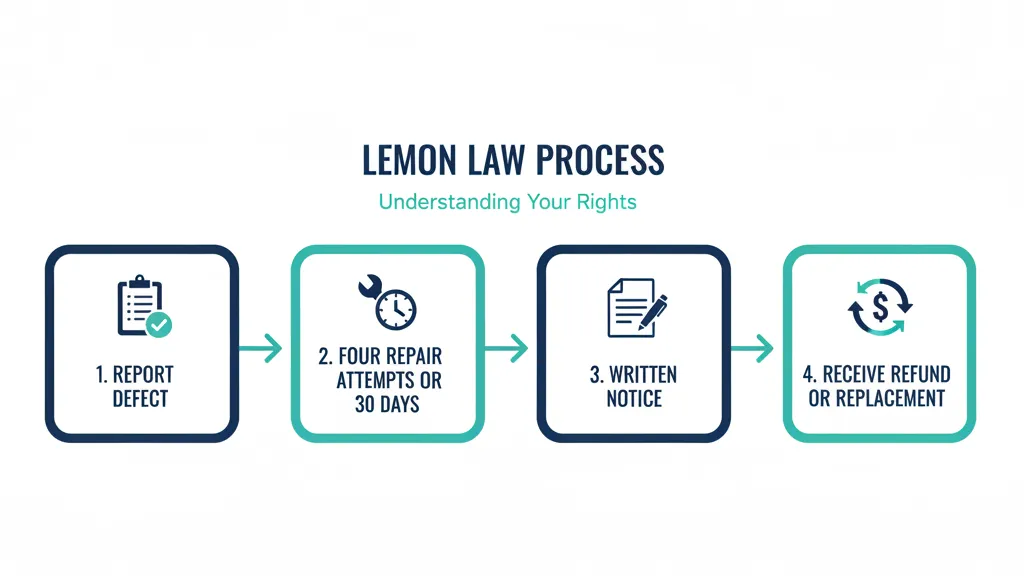
After the third repair attempt or 25 days out of service, you must send written notice to the manufacturer to take advantage of the remedies under the state lemon law. This is a critical step. The manufacturer then has 5 business days to make a final repair attempt once the vehicle is delivered. If the problem persists after this final opportunity, you may be entitled to a state lemon law remedy.
Many consumers make the mistake of continuing to go back to the dealer without ever formally notifying the manufacturer. This can delay your claim. An experienced Michigan lemon law attorney can handle this notice process correctly the first time.
When your vehicle qualifies as a lemon under Michigan law, the manufacturer must provide one of two remedies. The following table compares your options:
| Full Refund | Replacement Vehicle | |
|---|---|---|
| What you receive | Full purchase price returned | Comparable new vehicle |
| Taxes and fees | Included in refund | Covered by manufacturer |
| Collateral charges | Registration, title fees reimbursed | Transferred to new vehicle |
| Incidental damages | Towing, rental car, repair costs | Towing, rental car, repair costs |
| Use allowance deduction | Yes, with some limitations | No deduction |
| Loan/lease payoff | Manufacturer pays off your loan | Lease transferred to new vehicle |
| Best when | You want out of the vehicle entirely | You liked the vehicle model but got a defective unit |
The manufacturer provides you with a comparable new motor vehicle that is acceptable to you. The replacement must include:
The manufacturer refunds the full purchase price of the vehicle, including:
The manufacturer is allowed to deduct a reasonable allowance for use, calculated based on the miles you drove before first reporting the defect. This use allowance is typically a fraction of the vehicle’s purchase price, based on a formula that considers the mileage at first report versus the expected useful life of the vehicle.
Under both Michigan’s Lemon Law and the federal Magnuson-Moss Warranty Act, the manufacturer may be required to pay your reasonable attorney fees if you prevail. This means most firms will not charge you anything out of pocket. At Kahn & Associates, we handle Michigan lemon law cases on a pure contingency basis. If we do not recover compensation for you, you owe us nothing.
This is one of the most frequently asked questions we receive: does Michigan’s lemon law cover used cars?
| New Vehicles (State Lemon Law) | Used Vehicles (Federal Warranty Law) | |
|---|---|---|
| Governing law | Michigan MCL 257.1401-1410 | Magnuson-Moss Warranty Act (federal) |
| Warranty required | Manufacturer’s express warranty | Any active written warranty |
| Mileage limit | Within warranty or 1 year from delivery | No mileage limit if warranty was active |
| Vehicle types | Passenger cars, SUVs, pickups, vans | All vehicle types including RVs, motorcycles, boats |
| Remedies | Refund or replacement | Cash compensation, repair costs, expenses |
| Attorney fees | Manufacturer may pay if you win | Manufacturer may pay if you win |
| Common scenarios | Brand-new car with factory defect | CPO vehicle, used car with remaining warranty |
Michigan’s state Lemon Law (MCL 257.1401-1410) does not specifically cover used vehicles in most situations. The law was written primarily for new motor vehicles.
However, there is an important exception: if a used vehicle is still covered by the manufacturer’s original express warranty at the time of purchase, it may still qualify under the state lemon law. For example, if you buy a one-year-old certified pre-owned vehicle that still has two years of factory warranty remaining, and the vehicle develops a qualifying defect, you may have a claim.
Even when the state lemon law does not apply, the federal Magnuson-Moss Warranty Act provides broad protections for used vehicle buyers. This federal law:
At Kahn & Associates, we regularly use the Magnuson-Moss Warranty Act alongside state law to maximize results for our clients, even when their cases do not fit neatly into the state lemon law framework. Our 29 years of experience handling these cases means we know exactly which legal avenue gives you the strongest position.
If you believe your vehicle qualifies as a lemon, here is the process to pursue your claim.
Start keeping detailed records from the very first sign of trouble:
Documentation is the foundation of every successful lemon law claim. The more number of repair orders for repeated significant problems and the more detailed your records, the stronger your case.
This may seem counterintuitive, but you need to give the manufacturer a reasonable opportunity to fix the problem. Do not stop going to the dealer just because they have failed before. Each documented repair attempt strengthens your case.
Always use an authorized dealer for warranty repairs. Using an independent mechanic may not count toward the repair attempt requirement.
After reaching 3 repair attempts for the same defect or 25 days out of service, send formal written notice to the manufacturer. This notice should:
Send the notice via certified mail with return receipt requested so you have proof of delivery.
After receiving your notice, the manufacturer has 5 business days to make one final repair attempt once the vehicle is delivered. If they fail to fix the problem, or if they do not respond within that timeframe, you may be entitled to your remedy.
While you can pursue a lemon law claim on your own, working with an experienced attorney significantly increases your chances of a favorable outcome. Here is why:
At Kahn & Associates, we have recovered over $65 million for more than 13,000 consumers as of the date of this article. Most of our cases settle without going to court. Our free 60-Second Lemon Law Assessment can tell you in minutes whether you have a viable case.
Some manufacturers operate informal dispute settlement programs (also called arbitration programs). Michigan law requires these programs to comply with Federal Trade Commission regulations. While you may be required to go through arbitration before filing a lawsuit, the arbitration decision is not binding on you. If you are unsatisfied with the arbitration result, you can still pursue legal action.
Yes. Michigan’s Lemon Law, officially the New Motor Vehicle Warranty Act (MCL 257.1401-1410), has been protecting consumers since 1986. It requires manufacturers to repair defects that impair the use, or value of new vehicles. If they fail after a reasonable number of attempts or amount of time, you are entitled to a refund or replacement.
The Michigan state lemon law primarily covers new vehicles. However, used vehicles that are still under the manufacturer’s original express warranty at the time of purchase may qualify. Additionally, the federal Magnuson-Moss Warranty Act provides warranty protections for used vehicles with any active warranty, regardless of mileage or age. Learn more about how to determine if your vehicle qualifies.
Yes. Additionally, leased vehicles are protected under the federal Magnuson-Moss Warranty Act.
If you are leasing a defective vehicle in Michigan, contact us for a free case evaluation to discuss your specific situation.
Michigan’s state lemon law does not cover motor homes. RVs and motor homes can also be pursued under the federal Magnuson-Moss Warranty Act, which has broader vehicle coverage.
The process can take approximately 60-120 days from demand to resolution, though complex cases and certain manufacturers and other factors may make it take longer. If the case does not settle pre-suit and you have to file a lawsuit, the court process may take six months to a year or more depending on the court.
No. Most lemon law attorneys work on a contingency basis, meaning they are only paid if you win or settle. Additionally, state and federal lemon laws provide a mechanism for manufacturers to pay your attorney fees and costs when a case is won or settled. If your case is not successful at our firm, you owe nothing.
You might be wondering whether you really need an attorney or if you can handle a lemon law claim on your own. While Michigan law and the court systems do allow consumers to file claims without legal representation, there are compelling reasons to work with an experienced lemon law firm.
Every major vehicle manufacturer has attorneys and claims adjusters whose job is to minimize payouts. They know the law inside and out, and they know how to use procedural technicalities to deny or delay claims. An experienced lemon law attorney levels the playing field.

Knowing what your case is worth is critical. Manufacturers frequently offer settlements that are far below what consumers deserve.
Craig Kahn and his team handled the landmark case Royster v. Toyota Motor Sales, U.S.A., Inc. from the trial court all the way to the Ohio Supreme Court in 2001, establishing the legal precedent that 30 or more cumulative days out of service creates a presumption of lemon law relief, regardless of whether the vehicle is ultimately repaired. That decision is now used by professors and attorneys nationwide and continues to benefit vehicle owners.
Between the repair attempt requirements, manufacturer notice provisions, arbitration procedures, court rules and procedures if it has to be filed in court and settlement negotiations, a lemon law claim involves many steps where a mistake can delay or derail your case. Let a law firm handle everything, so you can focus on your life while they fight for your compensation. Our lemon law buyback guide explains what to expect during the process.
This bears repeating: a Michigan lemon law attorney costs you nothing out of pocket. The manufacturer pays your legal fees if we win. If we do not win, you owe nothing. There is zero financial risk.
Ready to find out if your vehicle qualifies? Take our free 60-Second Lemon Law Assessment or call us at 1-888-536-6671. We have been fighting for consumers with defective vehicles for over 29 years as of the date of this article, and we are ready to fight for you.
Lemon Law Protections in Your State: Florida Lemon Law, North Carolina Lemon Law, Ohio Lemon Law, Pennsylvania Lemon Law, Federal Lemon Law
*Disclaimer: The information contained in this Website is provided for informational purposes only, and should not be construed as offering legal advice, or creating an attorney client relationship between the reader and the author. While we aim for accuracy, the law is constantly changing and we make no guarantees regarding the completeness or timeliness of the information. You should not act or refrain from acting on the basis of any content included in this Website without seeking appropriate legal advice about your individual facts and circumstances from an attorney licensed in your state.
To see if you qualify, fill out the form below or call us at 1-888-536-6671 – No Office Visit Needed!

I had a great experience with Kahn & Associates! They made the process of dealing with an extremely frustrating lemon situation painless. They have very quick response times and everyone I dealt with was very friendly and helpful. Would definitely recommend!
Kahn and Associates did an awesome job with our lemon law case! We were getting nowhere with VW Customer Service and decided to hire an attorney who specialized with lemon law cases. We couldn’t be happier with the outcome. We were able to get a full refund on our lemon VW Atlas.
What a great experience! I was on the fence about hiring an attorney for my ongoing automotive issues and continued frustration with the manufacturer. It was a very simple process and I am very grateful Kahn and Associates for helping get me a settlement!
Real Honest attorneys!!! They are the real deal! I went back and forth with them and they explained to me every step and my rights under the law! I give them 5 stars because I won!!! Yes and my check is coming to me much sooner than I thought! I was stuck ! I own a brand new car and the dealer was giving me a hard time !

This page has been written, edited, and reviewed by a team of legal writers following our comprehensive editorial guidelines. This page was approved by Attorney Craig A. Kahn, who has more than 20 years of legal experience in lemon law.
If you bought or leased a new vehicle in Florida and it keeps breaking down despite repeated trips to the d...
Repeated transmission shuddering or an engine that burns oil between services turns a car you trusted into ...
It’s beyond frustrating. You bought or leased a new vehicle, but it spends more time at the dealershi...

Stuck with a defective car in Ohio? State Lemon Laws protect you. Get a refund, replacement, or cash settlement. Learn your rights today!

Florida Lemon Laws cover new and used vehicles. If your car’s a lemon, you deserve compensation. Let us help you fight for justice!

Michigan’s Lemon Law protects you from faulty vehicles. Don’t settle for endless repairs—claim your refund or replacement now.

North Carolina Lemon Laws ensure defective vehicles are replaced or refunded. Know your rights and take action today!

Pennsylvania Lemon Law covers new cars with repeated issues. Get the compensation you deserve. Click to learn more!
To see if you qualify, fill out the form below or call us at 1-888-536-6671 – No Office Visit Needed!

The Truth About Attorney’s Fees in Lemon Law Cases Learn more
*Disclaimer: The information contained in this Website is provided for informational purposes only, and should not be construed as offering legal advice, or creating an attorney client relationship between the reader and the author. While we aim for accuracy, the law is constantly changing and we make no guarantees regarding the completeness or timeliness of the information. You should not act or refrain from acting on the basis of any content included in this Website without seeking appropriate legal advice about your individual facts and circumstances from an attorney licensed in your state.

 Message Us
  Call Us