
Have A Case? Call Us
1 888-536-6671
60 Second Lemon Law Assessment™
60 Second Lemon Law Assessment™
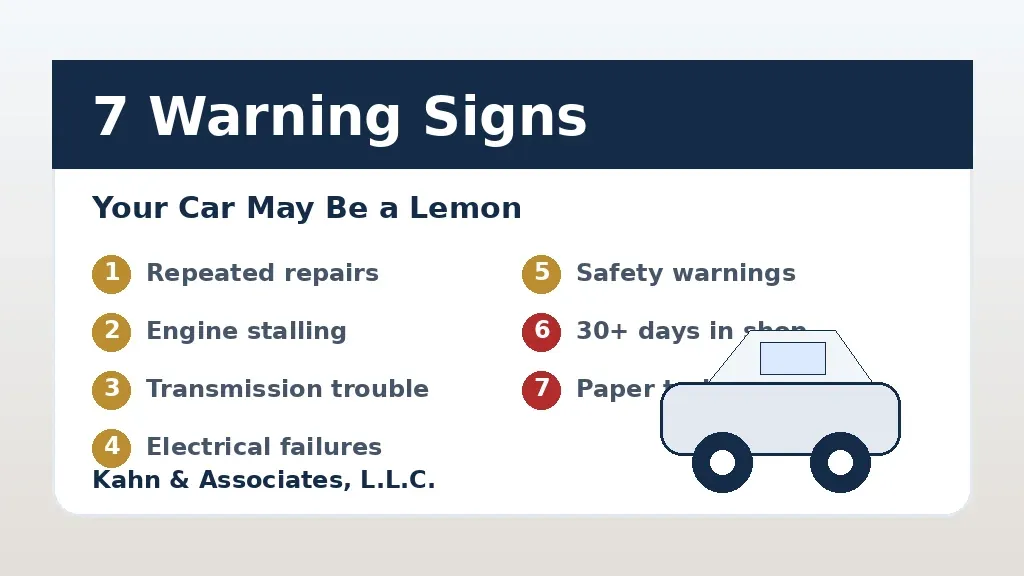
The second or third repair visit is often when frustration turns into a legal question: why is the same Honda defect still happening after the dealership has had repeated chances to fix it? A Honda lemon law claim may help owners and lessees pursue a buyback, replacement vehicle, cash compensation, loan payoff, or another remedy when a covered defect keeps returning under warranty.
Think your Honda might qualify? Start with Kahn & Associates’ 60-Second Lemon Law Assessment or call 1-888-536-6671. The review is free, no office visit is needed, and you pay nothing unless there is a recovery.
Honda has a strong reputation for reliability, but even respected vehicles can develop repeated defects that affect daily use, value, or safety. CR-V, Civic, Accord, Pilot, and Odyssey owners have reported concerns involving steering, fuel systems, transmissions, braking, electrical systems, infotainment displays, battery drain, warning lights, and driver-assistance technology. A single service visit does not automatically make a vehicle a lemon. But repeated failed repairs or excessive time out of service can make the repair history worth legal review.
Kahn & Associates represents consumers in Ohio, Florida, Michigan, North Carolina, and Pennsylvania. The firm focuses on manufacturer warranty claims and has helped consumers recover more than $65 million since 1996, as of the date of this article.
A Honda lemon law claim is a legal claim against the manufacturer when a vehicle has a substantial warranty defect that is not fixed within a reasonable number of repair attempts or after the vehicle spends more time at the repair shop than is reasonable. There is no single nationwide Honda lemon law. Each state has its own requirements, and the federal Magnuson-Moss Warranty Act may also apply when a vehicle is covered by a written warranty.
The central issue is usually not whether a Honda model has complaints online. The central issue is whether your specific vehicle has a documented warranty problem that the authorized dealer or manufacturer has had a fair chance to repair. Repair orders, dates, mileage, symptoms, parts replaced, software updates, and dealer notes all matter.
For used Honda vehicles, the warranty question is especially important. Kahn & Associates may be able to review used or certified pre-owned vehicles when they are still covered by a manufacturer warranty. But the firm does not bring cases against dealers for fraud or related sales-practice violations.
No article can tell you whether a specific Honda qualifies without reviewing the repair history. Still, certain defect patterns should be documented carefully when they happen repeatedly under warranty.
Steering concerns deserve immediate attention because they can affect safety and confidence behind the wheel. Honda and NHTSA materials have identified steering gearbox concerns in certain newer Honda and Acura vehicles. Including some Civic and CR-V models, where an incorrectly manufactured steering gearbox assembly may cause excessive internal friction and difficulty steering. NHTSA notes that difficulty steering can increase crash risk.
If your Honda feels sticky, notchy, unusually heavy, or difficult to keep centered, report the exact condition to the dealer. Ask that your complaint be written clearly on the repair order. If the repair facility says it cannot duplicate the condition, keep that paperwork too. Repeated “could not duplicate” visits can still matter when the problem continues.
Some Honda recalls and manufacturer communications have involved fuel system issues. For example, Honda service information for certain 2023-2024 Accord Hybrid, 2025 Civic Hybrid. And 2023-2025 CR-V Hybrid vehicles described a high-pressure fuel pump concern that could lead to a fuel leak. With fire risk if a fuel leak occurs near an ignition source. A recall does not automatically create a lemon law claim, but an unresolved or repeatedly repaired fuel concern can be important evidence.
Document fuel odor, warning lights, hard starting, stalling, loss of power, repeated fuel pump repairs, or any instruction from the dealership not to drive the vehicle. If the dealer is waiting on parts, note the dates the vehicle was unavailable and whether you received a loaner or rental.
Honda owners sometimes seek help after repeated complaints about hesitation, jerking, slipping, harsh shifts, delayed engagement, vibration, or loss of power. These symptoms may involve the transmission, software, engine management, mounts, sensors, or related systems. The label matters less than the pattern: the problem was reported under warranty, the dealer attempted repairs, and the condition returned or remained unresolved.
Describe the symptom in consistent, specific language. Instead of saying only “drives weird,” write down whether the vehicle hesitates from a stop. Shudders at a certain speed, jerks when shifting, loses power on the highway, or produces warning lights. The more specific the repair order, the easier it is to evaluate the claim.
Braking complaints can include grinding, pulling, soft pedal feel, warning lights, premature wear, brake system alerts, or automatic emergency braking behavior that feels unexpected. NHTSA has investigated complaints involving automatic emergency braking in certain Honda Accord and CR-V vehicles. Safety investigations and complaints are not the same as proving a lemon law case, but they show why repeated safety-related symptoms should not be ignored.
If a braking or driver-assistance issue happens intermittently, record the date, road conditions, weather, speed. Dashboard messages, and whether cruise control, lane keeping, collision mitigation, or other safety features were active. Share the details with the dealer and ask that they appear on the repair paperwork.
Electrical problems can be difficult because they may disappear before the vehicle reaches the service department. Honda owners should take repeat no-start events, battery drain, dashboard warnings, sensor failures, keyless-entry problems, camera malfunctions, and intermittent electrical glitches seriously when they happen under warranty.
Photos and videos can help. If safe, take a picture of warning lights, error messages, a blank screen, or a failure to start. Keep towing records, battery test results, and any notes showing that the dealer replaced a battery, control module, sensor, harness, or software update without solving the underlying problem.
Infotainment issues may sound minor until the screen controls navigation, backup camera functions, phone connection, audio alerts, and vehicle settings. Honda service bulletins have addressed symptoms such as popping or crackling from speakers. No sound from the audio system, network loss messages, and display issues in certain Pilot and Passport vehicles. Odyssey owners have also reported infotainment and display concerns in various model years.
When infotainment failures affect safety features, cameras, sensors, or warnings, make that clear in the repair complaint. A frozen screen, network loss message, black display, or repeated audio failure should be documented like any other recurring defect.
A Honda lemon law review is not limited to one model. The stronger question is whether the vehicle has a repeated, documented warranty defect that substantially affects use, value, or safety.
The CR-V is a high-volume SUV used by commuters, families, and small businesses. CR-V owners may seek lemon law help for recurring steering concerns, fuel system problems, electrical issues, warning lights, braking complaints, infotainment failures, transmission hesitation, air conditioning concerns, leaks, or driver-assistance problems, among other things. If the same complaint has been presented more than once or the CR-V has spent significant time out of service, the records should be reviewed.
Civic complaints can involve steering feel, electrical problems, infotainment issues, engine warning lights, transmission behavior, brake concerns, and safety-system alerts, among other things. Because Civic owners often use the vehicle as daily transportation, repeated unreliability can quickly affect work, school, and family obligations. Keep every repair order, even if the dealer says the condition is normal.
Accord owners may report fuel system concerns, braking or driver-assistance complaints, electrical problems, hybrid-system warnings, transmission hesitation, infotainment failures, or repeated check engine lights, among other things. An Accord does not need to be undriveable every day to deserve review. A defect may still be substantial if it affects safety, reliability, value, or ordinary use.
Pilot owners often depend on the vehicle for family transportation, so recurring safety, infotainment, transmission, electrical, engine, or braking issues can be especially disruptive. If the dealer has replaced parts, updated software, or kept the vehicle for days without a durable fix, the repair timeline may be important.
Odyssey owners may face repeat concerns involving sliding doors, electrical systems, infotainment screens, cameras, battery drain, transmission behavior, engine warnings, braking, and driver-assistance features. Minivan defects can create practical safety concerns because the vehicle is often used to transport children, elderly relatives, or family groups.
There is no universal number that applies to every Honda, every state, or every defect. Many claims involve multiple repair attempts for the same issue, a serious safety concern that continues after repair. Or a vehicle that has spent an unreasonable amount of time at the dealership. Some state lemon laws include specific presumptions, but the facts can still deserve review even when they do not fit a simple checklist. For a broader eligibility overview, see Kahn & Associates’ guide to lemon law requirements.
Ask these questions:
If several of these apply, get the file reviewed before the warranty expires or before records become harder to obtain. You can also review related lemon law questions before your free case review.
Not every Honda repair creates a lemon law claim. The difference is usually the repair pattern, warranty status, and impact on use, value, or safety.
| Repair pattern | Why it matters | What to save |
|---|---|---|
| Same defect returns after service | Shows Honda or its dealer may not have provided a lasting warranty repair. | Repair orders, dates, mileage, and symptom notes. |
| Vehicle stays at the dealer for many days | Time out of service can support review even when repair attempts involve related issues. | Drop-off and pick-up records, loaner notes, and rental receipts. |
| Safety complaint is dismissed as normal | Steering, braking, stalling, or warning-light concerns can affect safe use. | Photos, videos, dashboard messages, and written dealer responses. |
| Used Honda still has manufacturer warranty | May not qualify under state lemon law, but can still qualify under federal lemon law. | Warranty documents, certified pre-owned paperwork, and repair history. |
Strong documentation can make a major difference. It helps show what happened, when the manufacturer had notice, how many opportunities were provided, and whether the vehicle remained under warranty.
Gather these items if possible:
Repair orders are especially important. Before leaving the dealership, confirm that the paperwork lists your actual complaint, dates in and out and mileage, not a vague phrase that misses the symptom. If the issue affects safety, say so clearly and ask that the concern be documented.
Possible outcomes depend on the state law, the warranty, the repair history, the vehicle, and the manufacturer response. A lemon law claim may result in a repurchase, replacement vehicle, cash compensation, loan payoff, or another negotiated resolution. Kahn & Associates reviews each case individually and avoids one-size-fits-all promises.
Attorney fee rules also depend on the law involved and how the case resolves. Many state lemon laws say attorney’s fees shall be paid if the consumer wins. While the Magnuson-Moss Warranty Act says attorney’s fees may be paid if the consumer wins. In negotiated settlements, especially before a lawsuit is filed, the amount of attorney’s fees paid by the manufacturer is a matter of what the parties agree to.
Kahn & Associates handles qualifying lemon law and warranty claims with no out-of-pocket fees or costs to the consumer, win or lose. That structure helps consumers get legal guidance without taking on hourly attorney bills while they are already paying for a defective vehicle.
Kahn & Associates starts by reviewing the vehicle, the warranty, the state, the repair history, and the specific defect pattern. The team looks for evidence that Honda or an authorized dealership had a reasonable opportunity to repair the problem and that the defect substantially affects use, value, or safety.
The review may consider:
The firm has represented consumers for more than 29 years, recovered more than $65 million as of the date of this article, and helped shape Ohio lemon law through the Royster v. Toyota litigation handled by Craig Kahn and his team. That experience matters when a manufacturer treats a recurring defect like a routine service inconvenience.
No. A recall alone does not automatically mean your vehicle qualifies. A recall can be relevant, but a lemon law review focuses on your repair history, warranty coverage, defect severity, and whether the problem was repaired within a reasonable opportunity.
Possibly. “Could not duplicate” paperwork does not end the analysis if the defect continues. Keep reporting the issue, document symptoms with photos or videos when safe, and keep every repair order.
Yes, but probably not under state lemon law. However, it may qualify under the federal lemon law.
Do not stop making payments without getting legal advice. Missed payments can create separate financial problems. A free case review can help you understand options before making decisions that affect your loan or lease.
If your Honda CR-V, Civic, Accord, Pilot, Odyssey, or another Honda model has repeated warranty repairs, do not wait until the records get stale, deadlines pass or the warranty expires. Kahn & Associates can review your repair history, explain whether the facts may support a claim. And help you understand possible next steps in Ohio, Florida, Michigan, North Carolina, or Pennsylvania.
Start now with a free case review. Complete the 60-Second Lemon Law Assessment or call 1-888-536-6671. We charge no out-of-pocket fees or costs, win or lose.
*Disclaimer: The information contained in this Website is provided for informational purposes only, and should not be construed as offering legal advice, or creating an attorney client relationship between the reader and the author. While we aim for accuracy, the law is constantly changing and we make no guarantees regarding the completeness or timeliness of the information. You should not act or refrain from acting on the basis of any content included in this Website without seeking appropriate legal advice about your individual facts and circumstances from an attorney licensed in your state.
To see if you qualify, fill out the form below or call us at 1-888-536-6671 – No Office Visit Needed!

I had a great experience with Kahn & Associates! They made the process of dealing with an extremely frustrating lemon situation painless. They have very quick response times and everyone I dealt with was very friendly and helpful. Would definitely recommend!
Kahn and Associates did an awesome job with our lemon law case! We were getting nowhere with VW Customer Service and decided to hire an attorney who specialized with lemon law cases. We couldn’t be happier with the outcome. We were able to get a full refund on our lemon VW Atlas.
What a great experience! I was on the fence about hiring an attorney for my ongoing automotive issues and continued frustration with the manufacturer. It was a very simple process and I am very grateful Kahn and Associates for helping get me a settlement!
Real Honest attorneys!!! They are the real deal! I went back and forth with them and they explained to me every step and my rights under the law! I give them 5 stars because I won!!! Yes and my check is coming to me much sooner than I thought! I was stuck ! I own a brand new car and the dealer was giving me a hard time !

This page has been written, edited, and reviewed by a team of legal writers following our comprehensive editorial guidelines. This page was approved by Attorney Craig A. Kahn, who has more than 20 years of legal experience in lemon law.
Buying or leasing a new vehicle should mark the beginning of a smooth, reliable journey. However, when a ve...
Your vehicle is at the dealership again, the repair date keeps moving, and you still need transportation. A...
If you're making monthly payments on a leased vehicle that spends more time at the repair shop than in your...

Stuck with a defective car in Ohio? State Lemon Laws protect you. Get a refund, replacement, or cash settlement. Learn your rights today!

Florida Lemon Laws cover new and used vehicles. If your car’s a lemon, you deserve compensation. Let us help you fight for justice!

Michigan’s Lemon Law protects you from faulty vehicles. Don’t settle for endless repairs—claim your refund or replacement now.

North Carolina Lemon Laws ensure defective vehicles are replaced or refunded. Know your rights and take action today!

Pennsylvania Lemon Law covers new cars with repeated issues. Get the compensation you deserve. Click to learn more!
To see if you qualify, fill out the form below or call us at 1-888-536-6671 – No Office Visit Needed!

The Truth About Attorney’s Fees in Lemon Law Cases Learn more
*Disclaimer: The information contained in this Website is provided for informational purposes only, and should not be construed as offering legal advice, or creating an attorney client relationship between the reader and the author. While we aim for accuracy, the law is constantly changing and we make no guarantees regarding the completeness or timeliness of the information. You should not act or refrain from acting on the basis of any content included in this Website without seeking appropriate legal advice about your individual facts and circumstances from an attorney licensed in your state.

 Message Us
  Call Us