
Have A Case? Call Us
1 888-536-6671
60 Second Lemon Law Assessment™
by Kahn & Associates - September 29th, 2026
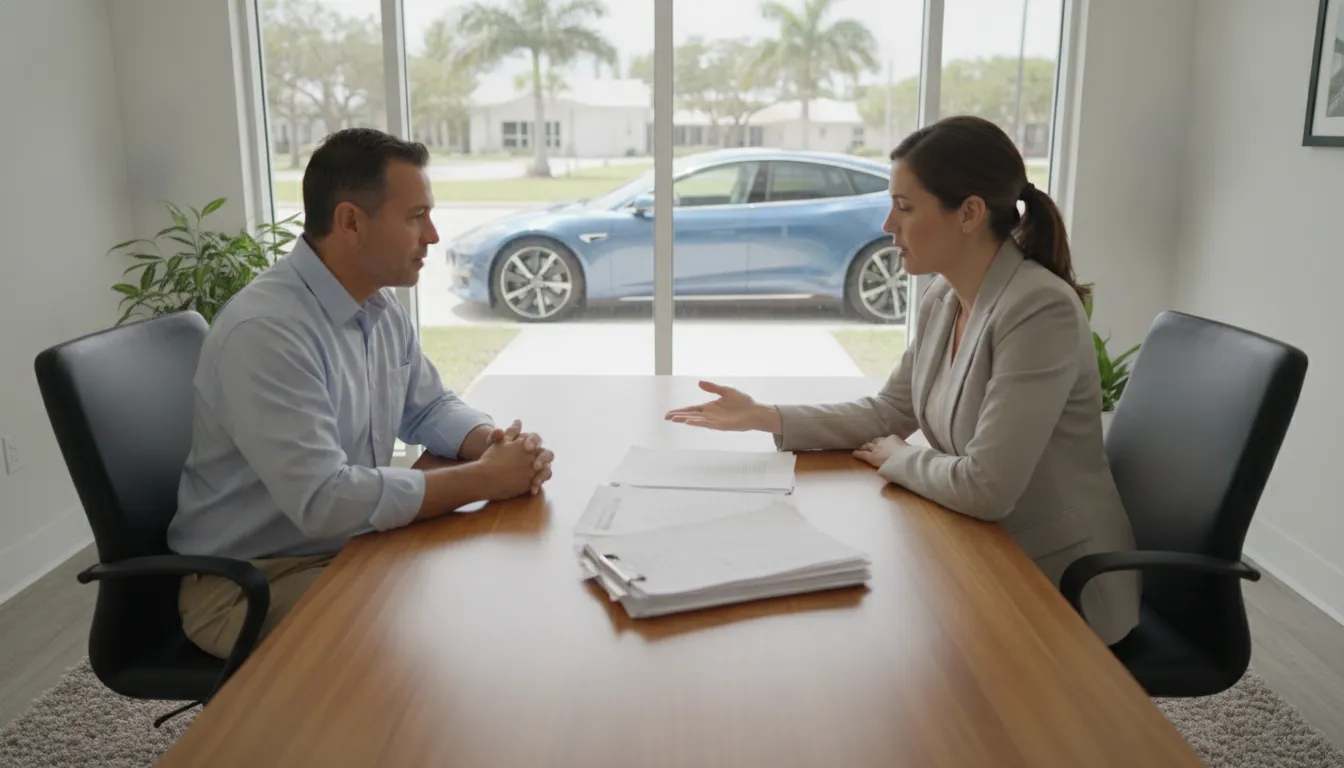
Two Florida drivers can be told the same thing — “your extended warranty does not cover that” — and be in completely different legal positions. One of them holds a written warranty from the vehicle manufacturer. The other holds a service contract sold by a company that never built a car. Florida law treats those differently, and the paperwork in your glovebox decides which one you have.
We have focused on Lemon Law and manufacturer breach-of-warranty matters since 1996 and, as of the date of this article, have represented more than 13,000 consumers and recovered over $65 million for clients. If your vehicle has been in for the same problem at least twice, or has been out of service for 21 days or more, you can request a free 60-second case review or call 1-888-536-6671.
The phrase gets used for at least three different documents. Only one of them is a warranty in the legal sense, and the distinction drives everything that follows — who owes the repair, what you can recover, and whether the Florida Lemon Law is even in the conversation.
| What it is | How to recognize it | What a denial means |
| The manufacturer’s written warranty, including extensions | Came with the vehicle. You did not buy it separately and there is no deductible. This includes the original coverage, any extension the manufacturer later issues for a known defect (often announced by letter), and certified pre-owned coverage that the manufacturer itself provides rather than sells as a separate plan. | A refusal to honor or multiple failed repair attempts can be a manufacturer breach-of-warranty claim, and the Florida Lemon Law may apply if the timing fits. |
| A manufacturer-branded service contract | Sold to you separately at the dealership under the manufacturer’s name. It has its own price and usually a deductible, and the obligor named in the contract is the manufacturer or an affiliate. | A contract claim against the manufacturer or its affiliate — not the same as a warranty breach, but owed by a company that also owes the original warranty. |
| An independent service contract | Sold separately by a company unconnected to the brand, often through a finance office, a marketer, or direct mail. Its own price, its own deductible, and an administrator or obligor with no relationship to the manufacturer. | A contract claim against a business that has no obligation for the vehicle itself. |
The quickest test is the one most people can run from memory: did you pay separately for it, and is there a deductible? If the answer to both is no, you are almost certainly holding a manufacturer warranty rather than a service contract. A warranty extension issued because of a known defect is still the manufacturer’s written warranty — it simply covers one component for longer. Certified pre-owned coverage needs a closer look, because some programs provide manufacturer warranty coverage as part of the certification while others bundle a separately priced service contract alongside it. Check whether it appears as a line item on your purchase paperwork.
The Federal Trade Commission explains the general difference between auto warranties and auto service contracts. It is worth reading before you rely on the word “warranty” as it appears in a sales folder, because the folder is not the document that controls.
This also determines whether the matter is one our firm can help with. We handle manufacturer warranty claims and extended coverage the vehicle manufacturer itself backs, because those run against the company that owes the vehicle’s warranty. We do not handle disputes with independent service contract companies. If an independent administrator denied your repair, what follows still describes your situation — you will want a firm that takes those contracts.
A denial does not prove a breach. Whichever document applies, start with what it says: which components and defects are covered, how long coverage runs, and which exclusions or conditions attach. A problem outside those terms may support no claim at all, however expensive the repair.
The denial worth examining is the one where the defect appears covered, the vehicle was inside the coverage period, and the stated reason does not match the written terms. With a manufacturer warranty, that means comparing the repair orders and the denial against the warranty booklet and any extension letter. With a service contract, it means comparing them against the contract’s own coverage and exclusion language. The documents are different, so the proof is different.
Where the Florida statute does apply, the federal Magnuson-Moss Warranty Act may. It covers written warranties, implied warranties, and service contracts alike, and it allows a consumer who finally prevails to recover costs and attorney fees. Our review of federal warranty protections and our comparison of federal and state lemon law set out how the paths differ. We evaluate every claim under both Florida and federal law.
Two separate questions get run together here, and the answers point in different directions.
Coverage. Federal law generally prevents a manufacturer from conditioning warranty coverage on using its own dealer or branded parts. So coverage is not forfeited merely because routine maintenance happened at an independent shop or an aftermarket part was installed. What can change the analysis is whether that part was defective or wrongly installed and actually caused the damage to the covered component — the connection between the part and the claimed defect, not the identity of whoever rotated the tires.
Repair attempts. This is the part that surprises people. Under a manufacturer’s warranty, and under the Florida Lemon Law, the repair opportunities that count are the ones given to the manufacturer or its authorized service agent. A visit to an independent shop does not count as one of them, no matter how many times you went or how well documented it is. A driver who spent a year chasing the same problem at a trusted local mechanic may have no qualifying repair attempts at all.
If the vehicle is under a manufacturer warranty and the problem is covered, take it to an authorized dealer and get a repair order every time — including the visits where nothing is found. Those documents are the record the entire analysis runs on.
The Florida Lemon Law addresses qualifying motor vehicles that fail to conform to the manufacturer’s warranty. A separately purchased service contract sits outside it, because the obligation comes from that contract rather than from the warranty. Which analysis applies turns on which document is involved, the vehicle’s history, and when the problem was first reported.
Florida’s Lemon Law rights period ends 24 months after the vehicle is first delivered to the consumer. A defect reported to the manufacturer or its authorized service agent inside that window obliges the manufacturer to make the repairs necessary to conform the vehicle to the warranty. A repair that happens afterward does not extend the period.
Within that window, a vehicle may be presumed a lemon after three or more repairs of the same nonconformity plus a final repair attempt by the manufacturer, or after 30 or more cumulative days out of service for repair, excluding downtime for routine maintenance listed in the owner’s manual. There is a separate, earlier figure that gets confused with it: reaching 15 or more cumulative out-of-service days triggers a required written step with the manufacturer. That is not a qualifying threshold on its own, and reaching it is a reason to call an attorney rather than to work the procedure out from a form online.
Florida’s timing is less forgiving than most people expect, and it runs on more than one clock. The rights period ends at 24 months from original delivery. The defect has to be reported inside it. Then there are strict deadlines for filing for arbitration and even a lawsuit.
Those windows interact, and which one governs depends on what has already happened with the manufacturer. That is the practical reason to ask early: the question is rarely “is there a case” so much as “which clock is already running.” Our guide to Florida Lemon Law requirements and deadlines covers the dates in more detail, and the Florida Statutes carry the definitions themselves.
It depends on which document and which path fits the facts.
| Possible path | What may trigger review | Possible relief, in general terms |
| Florida Lemon Law | A qualifying vehicle that still does not conform to the manufacturer’s warranty after the statutory repair opportunities | Repurchase, with the outstanding loan paid off as part of it, or an acceptable replacement vehicle, plus applicable incidental and collateral charges. Florida’s statute directs a court to award a prevailing consumer reasonable attorney’s fees, pecuniary loss, and costs. |
| Manufacturer’s written warranty breach | An active manufacturer warranty or warranty extension, a covered defect, and a failure to repair or otherwise honor the written terms | Compensation or other remedies supported by the warranty and applicable law. Attorney’s fees may be recoverable under the federal Magnuson-Moss Warranty Act where a consumer finally prevails. |
| Service-contract dispute | A repair that appears to fall inside a service contract, followed by a denial or a failure to pay | Contract-based relief such as payment for the covered repair. Because Magnuson-Moss reaches service contracts, its fee provision can apply here as well. |
The fee provisions are worth dwelling on, because they are often what makes a claim viable at all for an attorney to be involved. Florida’s Lemon Law directs the court to award a prevailing consumer reasonable attorney’s fees and costs, and Magnuson-Moss allows a prevailing consumer to recover fees based on time reasonably expended. Fees in a negotiated resolution are typically agreed between the parties rather than awarded by a court.
A free case review connects what happened to the document that controls it. It starts with which coverage actually applied — manufacturer warranty, manufacturer-backed plan, or independent contract — then the reported defect, the repair history, and what happened when an authorized facility was asked to fix it.
From there it is a question of records: the warranty booklet or contract, repair orders, service records, the purchase or lease agreement, registration, number of repairs and any written denial, if any. Dates, mileage, and days out of service all matter, and where records are missing, a free case review identifies what to request and from whom. Our Florida Lemon Law guide is useful while you gather them.
Where representation is appropriate, the firm contacts the manufacturer, presents the claim, and negotiates on the consumer’s behalf. Cases are handled on a contingency basis with no out-of-pocket fees or costs. Our fee comes from the recovery, typically with the manufacturer paying some of all of the fees, not from any money in your pocket before the case resolves. A free case review is not a promise that a claim qualifies or that any particular result will follow.
Not necessarily, and the difference matters. If the coverage came with the vehicle, you did not pay for it separately, and there is no deductible, it is the manufacturer’s written warranty — including an extension issued for a known defect. If you bought it separately and it carries a deductible, it is probably a service contract, even when the manufacturer’s name is on it.
Often, but check the paperwork. Some certified pre-owned programs provide manufacturer warranty coverage as part of certification, with no separate charge or deductible. Others bundle a separately priced service contract alongside the certification. Whether it shows up as a line item on the purchase agreement usually answers the question.
The Lemon Law addresses vehicles that fail to conform to the manufacturer’s warranty, so a dispute under a separately purchased service contract generally falls outside it even where the same defect is involved. A dispute about the manufacturer’s own warranty, including an extension, can fall within it if the timing and repair history fit.
Toward repair attempts, those visits do not count: the opportunities that matter are the ones given to the manufacturer or its authorized service agent. Take a covered problem to an authorized dealer and keep the repair order.
You do not need to sort that out before you call. Whether the coverage came with the vehicle or was sold to you separately, whether a repair was denied outright or the dealer simply cannot fix the vehicle timely, whether you are two visits in or still wondering if it is worth mentioning — those are the questions a free case review can answer.
It also does not have to be a denied repair. If the same problem keeps coming back, if the vehicle has spent weeks at the dealership, if a manufacturer has offered you something and you do not know whether it is reasonable, or if you just want to know whether the Florida Lemon Law or the Federal Lemon Law reaches your situation at all, those are worth a conversation. If you’re in Florida, Ohio, Michigan, North Carolina, or Pennsylvania — we represent consumers in all five states, and the rules differ in each.
Received a denial or been in for at least two repair visits for the same problem, or 21 days out of service? That is enough to contact us. Request a free 60-second case review or call 1-888-536-6671. There is no cost to find out where you stand.
*Disclaimer: The information contained in this Website is provided for informational purposes only, and should not be construed as offering legal advice, or creating an attorney client relationship between the reader and the author. While we aim for accuracy, the law is constantly changing and we make no guarantees regarding the completeness or timeliness of the information. You should not act or refrain from acting on the basis of any content included in this Website without seeking appropriate legal advice about your individual facts and circumstances from an attorney licensed in your state.
To see if you qualify, fill out the form below or call us at 1-888-536-6671 – No Office Visit Needed!

I had a great experience with Kahn & Associates! They made the process of dealing with an extremely frustrating lemon situation painless. They have very quick response times and everyone I dealt with was very friendly and helpful. Would definitely recommend!
Kahn and Associates did an awesome job with our lemon law case! We were getting nowhere with VW Customer Service and decided to hire an attorney who specialized with lemon law cases. We couldn’t be happier with the outcome. We were able to get a full refund on our lemon VW Atlas.
What a great experience! I was on the fence about hiring an attorney for my ongoing automotive issues and continued frustration with the manufacturer. It was a very simple process and I am very grateful Kahn and Associates for helping get me a settlement!
Real Honest attorneys!!! They are the real deal! I went back and forth with them and they explained to me every step and my rights under the law! I give them 5 stars because I won!!! Yes and my check is coming to me much sooner than I thought! I was stuck ! I own a brand new car and the dealer was giving me a hard time !

This page has been written, edited, and reviewed by a team of legal writers following our comprehensive editorial guidelines. This page was approved by Attorney Craig A. Kahn, who has more than 20 years of legal experience in lemon law.
You bought a used car, and it's been in the shop more than on the road. That sinking feeling is all too rea...
Does your Silverado have the infamous “Chevy Shake”? Is your Equinox consuming an alarming amou...
If you lease a car, SUV, pickup truck, or van in Michigan and a serious defect keeps returning, you may hav...

Stuck with a defective car in Ohio? State Lemon Laws protect you. Get a refund, replacement, or cash settlement. Learn your rights today!

Florida Lemon Laws cover new and used vehicles. If your car’s a lemon, you deserve compensation. Let us help you fight for justice!

Michigan’s Lemon Law protects you from faulty vehicles. Don’t settle for endless repairs—claim your refund or replacement now.

North Carolina Lemon Laws ensure defective vehicles are replaced or refunded. Know your rights and take action today!

Pennsylvania Lemon Law covers new cars with repeated issues. Get the compensation you deserve. Click to learn more!
To see if you qualify, fill out the form below or call us at 1-888-536-6671 – No Office Visit Needed!

The Truth About Attorney’s Fees in Lemon Law Cases Learn more
*Disclaimer: The information contained in this Website is provided for informational purposes only, and should not be construed as offering legal advice, or creating an attorney client relationship between the reader and the author. While we aim for accuracy, the law is constantly changing and we make no guarantees regarding the completeness or timeliness of the information. You should not act or refrain from acting on the basis of any content included in this Website without seeking appropriate legal advice about your individual facts and circumstances from an attorney licensed in your state.

 Message Us
 Call Us